
Christmas Day falls on a Friday this year. For a growing share of exterior displays the question is no longer which string to buy, but which extrusion to install once and control for a decade.
A Friday Christmas and a longer display window
Christmas Day falls on Friday, December 25 this year, which gives the display season a firmer end point and typically stretches the period over which exteriors are lit. The practical consequence is that the hardware spends more nights, more hours and more thermal cycles under load than a two-week display was ever designed for. Seasonal strings are built for a short campaign. The architecture is not.
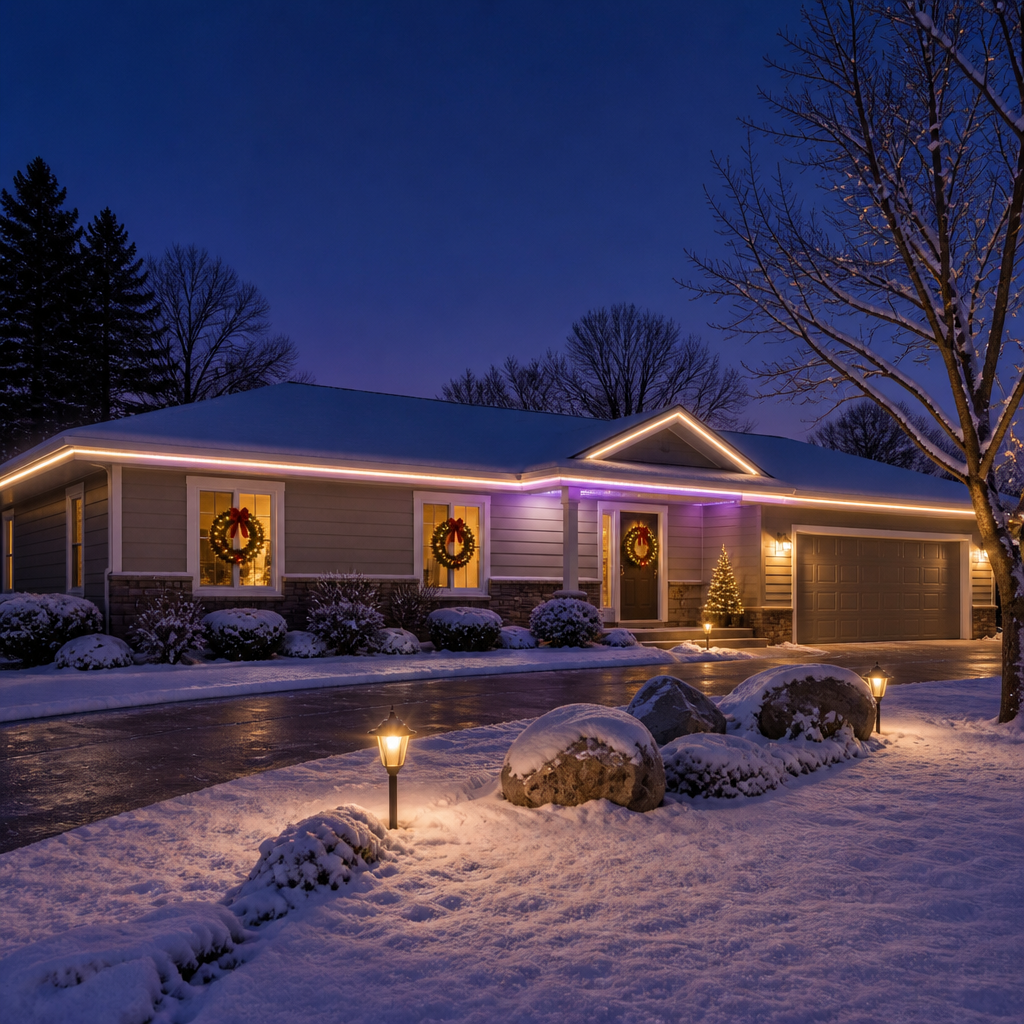
The permanent-install argument
The case for a permanent channel run is not only visual. Hanging and removing temporary strings from a roof is the part of the holiday season with the least margin for error: ladders, ice, wind and roof surfaces that are least predictable exactly when displays go up and come down. A channel mounted once at the fascia or soffit, with the strip and power inside it, removes the annual climb. It also removes the annual failure, because strings stored in a garage come back with cracked insulation, corroded sockets and dead sections that were working when they were taken down.
Warm white is a specification, not a colour name
The Christmas look that reads as expensive is not the brightest. It is the most consistent. Warm white exterior lighting in the 2700K to 3000K range, with high colour rendering and tight binning, produces the deep even glow that a facade framed with mixed-temperature strings cannot match. A diffuser does the rest: an opal polycarbonate cover turns point sources into a continuous bar, which is why a channel-built roofline at moderate brightness looks cleaner than a high-output string at twice the lumens.
Binning is the variable buyers most often miss. LEDs are sorted after production into bins by colour and output, and two reels of the same nominal colour temperature drawn from different bins will read differently along one continuous run – one slightly greener, one slightly pinker, with a visible seam in the middle of a gable. Specifying one bin per run, and buying that run from a single production batch, is what makes the line read as one object.
Where the light actually lands
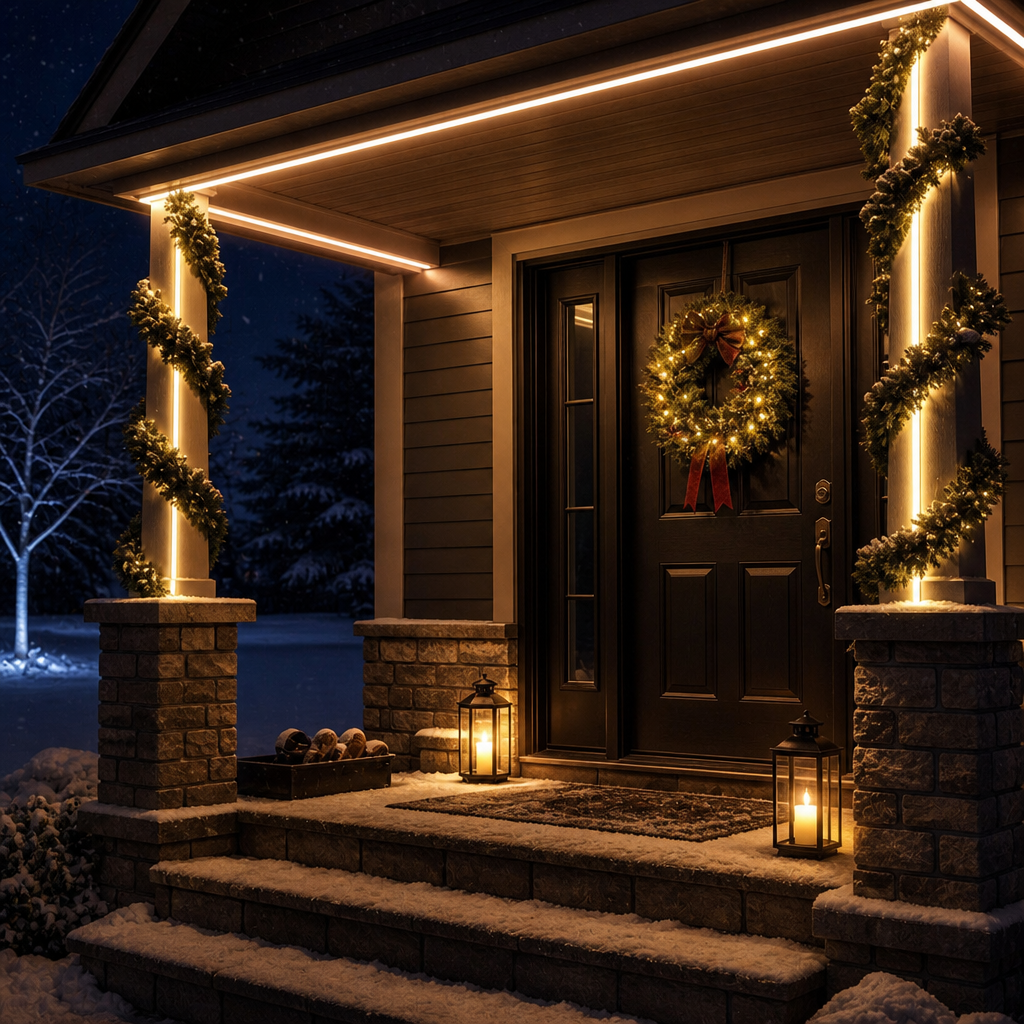
A channel run is not a spotlight, and the difference matters at gable height. Light leaves the diffuser across its full width, so the visible result depends on how far the channel sits from the surface it washes and which way that surface faces. Mounted tight under a soffit and aimed down the wall, the run produces a narrow, crisp grazing line that stays attached to the architecture. Set slightly away and angled outward, the same channel becomes a broad wash that lifts the whole roof plane and spills into the night air. Neither is wrong, but the tight grazing detail is usually the one that reads as composed from the street.
Overhang is the second variable. A deep soffit hides the source and keeps the light close to the wall; a shallow fascia puts the diffuser in view from below, which makes the quality of the profile visible and rewards a clean section and an even opal cover. Both decisions belong on the elevation drawing, before the channel is ordered, because neither can be corrected from a ladder in December.
Winter is the hardest test the hardware will face
Cold is not the enemy of an LED; heat is. In winter, lower ambient temperature actually helps the diode run cooler at the same drive current. The damage comes from cycling. Each switch-on and switch-off moves the assembly through a temperature range, and the materials in the system – strip adhesive, gaskets, end caps, the diffuser – expand and contract at different rates.
Snow introduces two further problems. Meltwater from snow sitting on a fascia finds its way into any profile that has not been detailed for drainage, and standing water against a strip is how an exterior installation fails in its second winter rather than its first. Salt and de-icing spray from a plowed driveway attack unfinished aluminum. Both are solved in the specification rather than on site: anodized or powder-coated extrusion, gaskets and closed end caps, and a channel with weep provisions or a mounting fall that lets water out.
Geometry: where rooflines actually break
The visual failure mode in exterior Christmas lighting is not brightness. It is the corner. A gable end, a valley between two roof planes and a porch return each require a change of direction, and a straight extrusion cannot make that turn without a joint, a shadow or an over-bent strip.
The fix is a section chosen for the geometry. V-shaped profiles are designed to be mitred or formed at 90-degree turns so the light line continues unbroken around the corner. Where a run is genuinely discontinuous, a purpose-made connector keeps the join invisible instead of leaving a dark gap. The most common reason a display looks amateur at gable height is that these two parts were left out of the order.
Control: from a plug to a schedule
Christmas displays are, in practice, a scheduling problem. Dusk-to-dawn operation for weeks at a time is the requirement, and a controller with astronomical timing handles it without a mechanical timer left to drift. The same controller is where a two-holiday system pays for itself: a warm-white channel run installed for December becomes a violet Halloween display through a colour preset, then returns to architectural accent lighting in the weeks between.
Zones matter on larger properties. Letting the roofline, the porch and the path be switched separately means the display can build toward the holiday rather than sitting at full output for two months, and it means a fault on one run does not take the whole facade dark.
Specifying the run
The shortlist for a permanent exterior channel is consistent. 6063-T5 extrusion, anodized or powder-coated. Opal polycarbonate diffuser. Gaskets, end caps and connectors rated for the same environment as the channel itself. 24V operation for long runs. A single colour bin per run. A listed low-voltage supply on a protected circuit. Mounting clips rated for cold, and drain or weep provisions for meltwater. V or corner sections wherever the geometry turns. None of these items is exotic, and each one is the difference between a line that looks drawn and a line that looks installed.
Post time: Oct-16-2026