
For most of the past two decades, exterior holiday lighting was a temporary condition. It went up in November, came down in January, and for eleven months the building looked exactly as the architect drew it. That arrangement has been quietly reversed. In a growing share of residential and light-commercial work, the lighting is installed once and left in place, with the seasonal effect delivered by control rather than by labour.
The hardware that made this possible is not the LED. It is the aluminium channel: an extruded profile fixed under the soffit or along the fascia, carrying the modules, concealing the cable, and, crucially, reading as part of the building when it is dark.
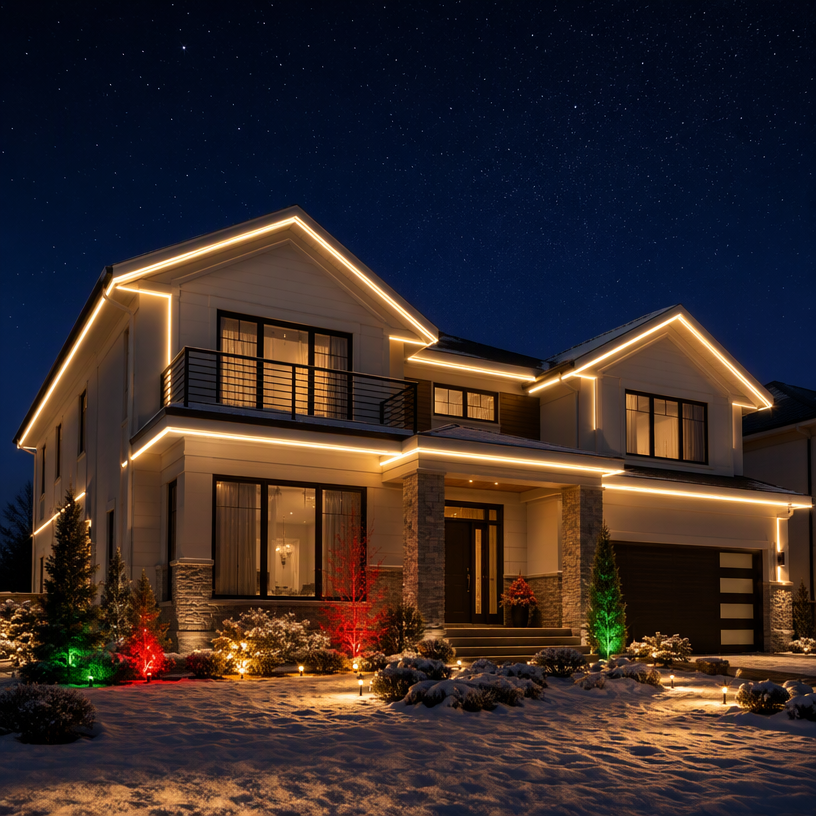
That change of status is the whole story. A product judged on how it looked in December is now judged on how it looks in July, and on whether it can be defended to an inspector, a homeowners’ association, or a municipal lighting officer. The channel sits at the intersection of two conversations that rarely happen in the same room: the engineering one and the regulatory one.
Angle one: the channel as a component, not an accessory
Once a profile is fixed to a building envelope and expected to stay, the requirements stop being cosmetic.
Finish is the first casualty. Powder-coated aluminium performs well in most environments, but a coastal installation is a different test: salt, wind-driven rain, and unbroken ultraviolet exposure. A coating that chalked slightly by year four was tolerable on a December accessory. On a permanent fixture it is a visible defect on a surface the customer sees every evening. The same applies to colour, because a finish chosen to match a fascia will be compared against that fascia for a decade, and paint fades at a different rate than powder coat.
Thermal behaviour matters for a reason that is easy to miss. An aluminium extrusion is a heat path as well as a mounting rail. In a closed profile the modules are thermally coupled to the metal, which helps at low drive currents and becomes a constraint when a run is pushed brighter. Ventilated profiles trade some of that coupling for convective cooling. Neither choice is universally right; the point is that the profile has become part of the thermal design rather than a bracket.
Length brings its own problem. Aluminium expands measurably over a six-metre run between a January night and a July afternoon. Continuous profiles need expansion allowance at joints, or the run will either buckle or pull its fixings. That is ordinary practice in curtain wall and cladding, and it is still inconsistently applied in lighting channels.
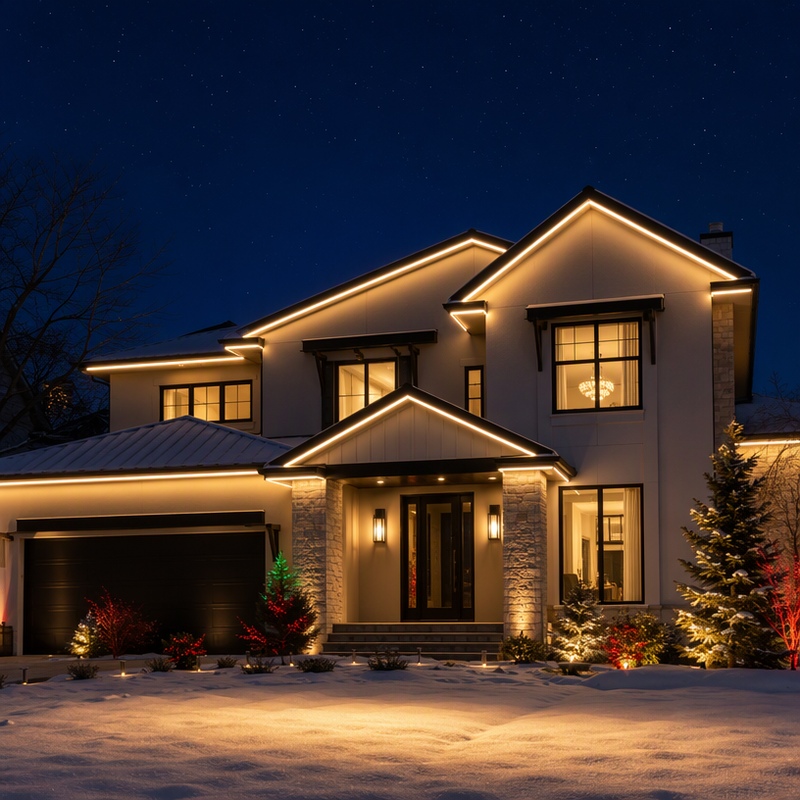
Then there is serviceability. A permanent system will have a module fail in year three or year four. Whether that is a fifteen-minute repair or a scaffold hire depends entirely on decisions made at design: whether the profile opens without being removed, whether modules are replaceable individually, whether the cable sits in the channel or behind it. A channel that hides wiring completely and cannot be reopened is a good December product and a poor permanent one.
Voltage drop completes the picture. Low-voltage runs are limited by distance as much as by load, so a long roofline becomes a power-distribution problem: multiple feeds, heavier conductors, or a higher distribution voltage with local conversion. Whichever route is taken, the decision belongs to the electrical design rather than to what happens to be in the installer’s van.
Angle two: the rulebook catches up
The second angle is less comfortable, and more consequential.
A seasonal display was, in most jurisdictions, treated as decoration. It existed for six weeks, it was unshielded, and nobody measured it. A permanent installation does not get that latitude. It is an installed exterior lighting system, and it is assessed as one, by the same instruments and often by the same officer as a parking-lot luminaire.
Light-pollution regulation is the live front. Through 2026 a growing number of municipalities have moved, or are moving, toward correlated colour temperature limits around 3000K for new and replacement exterior installations, shielding requirements, and curfews or mandatory dimming after a set hour. Proposals at city and state level have targeted unshielded residential illumination above defined lumen thresholds. The specifics differ; the direction does not. Warmer, shielded, dimmable, and accountable for hours of operation.
For a channel-based system this is less restrictive than it first appears, because addressable control turns compliance into a software setting. It is also harder, because the control layer that dims and schedules is now the thing that decides whether the installation is lawful after eleven at night. A system sold on colour capability and commissioned without a schedule is a compliance liability, not a feature.
Homeowners’ associations run a parallel process on different logic. Covenants are rarely written for permanent lighting, because the category barely existed when they were drafted. What they almost always contain is a clause about alterations to exterior appearance and a requirement for architectural review. A channel that is invisible by day may satisfy the spirit of that clause and still fail its letter if approval was never sought. The practical consequence for installers is that the approval step belongs in the quotation, not in the callback.
Electrical code adds the last layer. Low-voltage lighting systems are generally treated more lightly than line-voltage installations, but the definition turns on voltage and on whether the wiring is part of the building. Permanent wiring concealed inside a soffit is a different proposition from a plug-in seasonal set, and permits, inspection and connection method follow from that classification rather than from the product’s marketing category.
Where the two angles meet
The uncomfortable symmetry is this: the same decision that improves the installer’s economics, fix it once and programme it forever, creates the exposure. The channel that eliminates the annual ladder work also converts a tolerated seasonal nuisance into a permanent, inspectable, complaint-attracting installation.
Which means the specification has quietly changed. Finish durability, ingress protection, expansion allowance, module replaceability, control capability and scheduling now belong in the same document, and none of them substitutes for another. A system that is beautiful in December and unserviceable in year four has not solved the customer’s problem; it has deferred it.
The question worth asking at handover is no longer whether the channel will hold. It is whether, in the third year, the installation can be explained to anyone who asks why it is on the wall.
Post time: Nov-17-2026