
Decorating a house for Christmas has always been a job with a deadline, and the deadline was never merely administrative. It shaped the design. Six weeks of visibility meant every decision was made for maximum effect within a short window: density, saturation, contrast, and the willing suspension of restraint. A display that had to justify itself in a fortnight could not afford to be subtle.
That is changing, and the change is not primarily technical. Where the lighting is installed once and controlled thereafter, the display stops being an event and becomes a setting. A six-week window opens onto a year. The design problem inverts, and the aesthetic habits built up over decades of temporary installation quietly stop being rational.
What the deadline produced
More was more because there was less time. A short season rewards compression: every metre of available surface carries something, colour is pushed to the front, and the effect is measured in how far down the street it registers. The deadline also supplied an ending, and an ending is what made the excess legible as celebration rather than as a permanent condition. The compression explained the untidiness, too: nobody expected a six-week object to resolve properly at close range.
Anyone who has driven past a decorated house in late January knows the sensation. The lights are not wrong; the lights are late. The discomfort is temporal rather than visual, which is why no amount of good taste in the original installation fully prevents it.
Colour is the first casualty
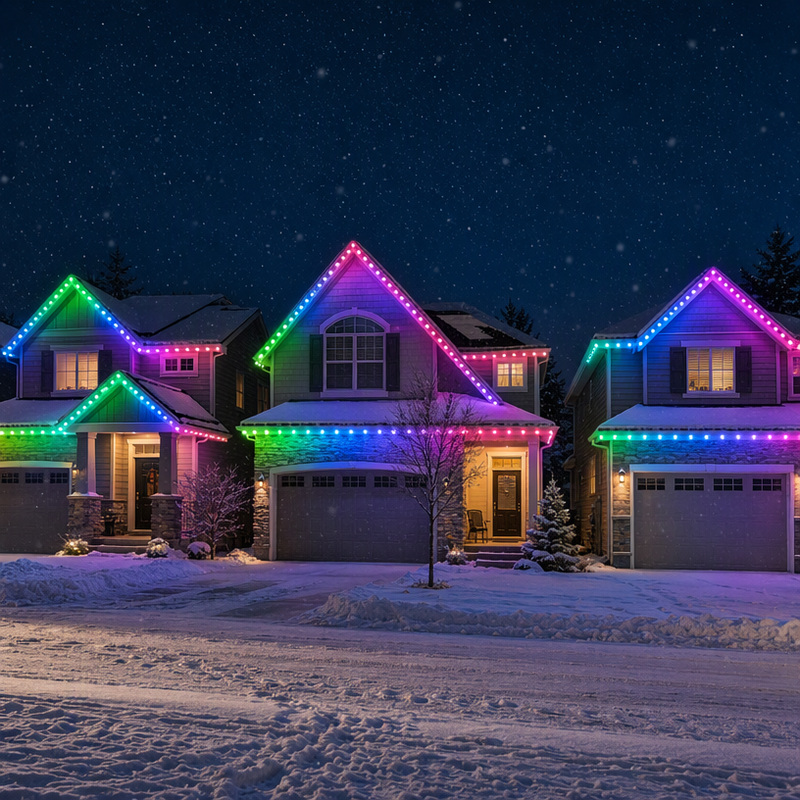
Multicoloured lighting reads as celebration in December and as a fairground in July, and nothing about the hardware alters that. The reading is supplied by the calendar, not the product.
Warm white survives the change of season because it does something different: at roughly 2700K to 3000K it approximates the colour of a lit interior seen through a window, so the eye files it as architecture rather than as festivity. That is the real reason permanent installations converge on warm white, and why colour is treated as an exception that is switched on rather than a default that stays on.
Colour-changing systems complicate this rather than solving it. Capability without a schedule produces a house that is red in February, and a house that is red in February is not decorated; it is malfunctioning, socially speaking.
The line is decided once
With temporary strings, the run was renegotiated every year. Nobody minded, because the whole thing was provisional. A fixed aluminium channel removes that flexibility and, with it, the annual correction.
The profile establishes where the light sits relative to the building, and that single decision produces entirely different buildings: a graze across the fascia, a wash down the soffit, a silhouette along the eave. Spacing and projection then determine whether the viewer sees the source or the effect, which is the difference between a lit house and a line of visible dots.
This is lighting design being settled as an installation question, usually on a ladder, frequently without an elevation drawing. It is the most consequential aesthetic decision in the whole project, and it is the one least likely to be documented.

The objection changes character
“Christmas lights still up in May” used to be a joke about neglect, a small and forgivable social failing. Permanent systems remove the neglect and keep the lights, so the objection has to find a new basis, and it settles on taste. Taste arguments are harder to win, because the same installation can be defended as tidy detailing and criticised as permanent festivity, and both descriptions are accurate.
Once the system can change colour on command, the house becomes a display surface with an owner-controlled schedule, and neighbours acquire opinions about someone else’s software settings. That is a genuinely new social fact. Covenants drafted before the category existed do not anticipate it, and most of them address appearance rather than operation.
What is actually lost
The making. Putting lights up was a craft, and a mildly unpleasant one: measuring in the cold, testing strings, the annual negotiation over how far up the gable to go. It produced the display and it also produced the memory of producing it, which is a large part of what a household remembers about December.
A commissioned system is more even, better weatherproofed and considerably safer, and it does not generate that memory. Something that was a household ritual becomes a service, renewed in an application. For a designer this is not nostalgia; it is a change of brief. The client is no longer asking for a display. The client is asking for a permanent feature that has to remain acceptable during eleven months it was never designed for.
Designing for the eleventh month
The working principle follows from that: design the off-season appearance first. If the channel reads as trim, a shadow line beneath the soffit or a fascia detail that was always missing, then December is a bonus. If it reads as hardware, no amount of December programming rescues it.
Restraint is not a style preference in this context; it is durability. Warm white at low output, aimed at a surface rather than at the eye, survives all twelve months. Saturation and direct view do not.
The test is unglamorous and worth stating: look at the house on an overcast afternoon in April, when nothing is switched on and the trim is all that remains. That is the version most people will actually see.
December, meanwhile, should be treated as the exception state: the month the system is permitted to be loud, with a defined start and a defined end. Everything else is the default, and the default is what the street sees for most of the year.
The deadline used to do the editing. It compressed the design, enforced an ending, and allowed excess to pass as celebration. Removing it did not remove the need for those decisions. It moved them earlier, to whoever is holding the drawing. Permanent lighting is not a decoration that lasts. It is a decoration that must be designed twice: once for the month it is meant for, and once for the eleven it is not.
Post time: Nov-17-2026