
A cable tray system earns its classification in a laboratory and its reputation on site. Between those two points sits an installation stage that decides whether the specified performance survives contact with a real structure, and it is the stage where most of the avoidable cost in a tray package is created.
The pattern repeats across project types. A system is selected from a catalogue against a load class and a finish. The drawing fixes a route. The structure that will carry it turns out to offer support points at intervals nobody chose, at a height that conflicts with other services, and through walls that require fire stopping. Each of those conditions is normal. Handled late, each becomes a variation.
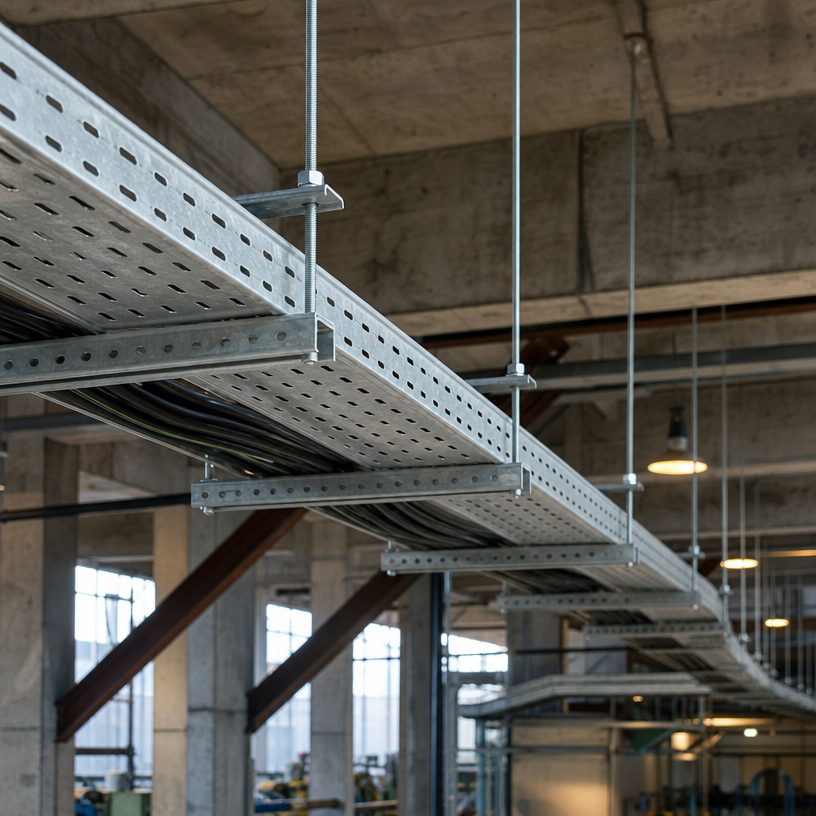
Where tray systems are actually used
The application range has widened rather than changed. Industrial plants remain the largest user, because process areas generate long runs of both power and control cable that have to be accessible for maintenance. Power generation and substations use tray for station service and protection circuits, often outdoors and frequently in galvanized or stainless finish. Data centres use it heavily above white space, where fill and segregation matter more than load. Commercial buildings use it above ceilings and in risers, usually in smaller sections and with tighter coordination against other trades. Infrastructure work, from tunnels to transport terminals, uses tray where cable routes must survive vibration and long service intervals.
What varies between these settings is not the product but the constraint that dominates. In a plant it is corrosion and access. In a data hall it is fill and airflow. In a commercial ceiling it is coordination and fire stopping. In infrastructure it is movement and vibration.
The installation variables that decide performance
Support spacing is the first. Published load and deflection data assume a span, and the span on a drawing is often set by the steel grid rather than by the cable. Where the available structure forces a longer span than the table assumes, capacity falls faster than the span rises. The correction is either more supports, a heavier section, or a shorter run between them, and all three cost less before the steel is erected than after.
Deflection follows the same logic and is easier to miss, because it does not appear until the run is loaded. Where a catalogue states a multiplier for single-span installation, the figure covers the change from continuous support to simple support at a penetration or at the end of a run. A design that ignores it will pass on paper and sag on site.
Movement is the second variable. Expansion joints, building movement joints and long straight runs in direct sun all require the tray to accommodate change in length. The common failure is not a collapsed run but a buckled one, where the tray was fixed rigidly at every support and had nowhere to go.
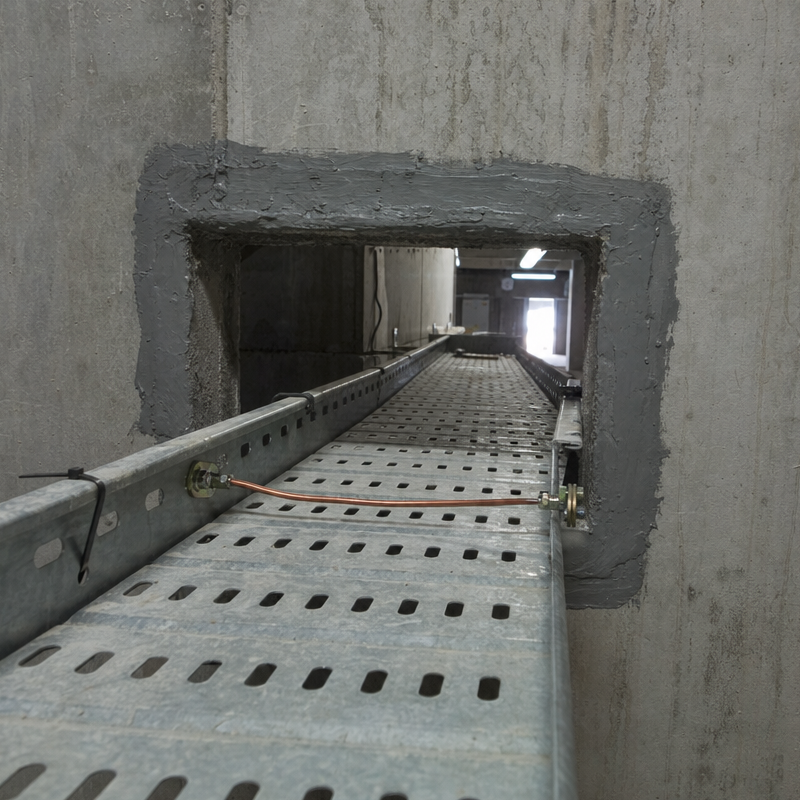
Penetrations are the third. Cutting a tray to pass through a wall creates two problems at once: the fire rating of the wall and the electrical continuity of the tray. Fire stopping is a specialist scope and is frequently left to a different trade, which is why the detail is often missing from the tray drawing. Continuity across the penetration is a design decision, not an installation one.
Cable pulling is a mechanical event that the tray either accommodates or resists. Radius fittings, smooth internal edges and rollers at direction changes protect the sheath; sharp cut ends and undersized bends do the opposite. Tension limits are set by the cable manufacturer, but the geometry that decides whether those limits are approached is set by the installation.
Segregation between power and communication cables is a routing decision taken on the tray drawing, and it becomes difficult to correct once both systems are in place. Barriers, separate trays on shared supports, or physical separation are the usual options, and each has an installation consequence that is cheaper to accept early.
Access for maintenance is the constraint most often traded away during coordination. A cover that cannot be lifted, or a run above a ceiling void with no walkway, turns a routine circuit addition into a shutdown.
Fill is the fourth, and it is the only one that gets worse after handover. A tray installed to a planned fill margin is usually revisited during fit-out, when additional circuits are added by trades who did not see the original calculation. Systems designed with spare capacity and with accessible covers survive that process; systems filled to the limit do not.
Prefabrication has moved the work, not removed it
Fittings, bends, tees and reducers are increasingly assembled off site, and modular support systems have reduced the amount of cutting and drilling at height. The effect on quality is real: a factory-made bend has a consistent radius, and a consistent radius protects the cable during pulling.
The effect on coordination is less often discussed. Prefabrication moves decisions earlier. A bend ordered in advance cannot accommodate a route change discovered on site, which means the drawing has to be right sooner, and the survey has to be done before fabrication rather than before installation.
What handover now asks for
The documentation expected at completion has grown. Load data and finish certificates are the baseline. Increasingly the pack also carries fill calculations, continuity readings for the earthing path, and evidence of fire-stopping at every penetration.
That shift changes what an installer needs from a supplier: fewer catalogue statements and more testable data, with the span, the support condition and the finish stage stated alongside the number. The discipline this requires is administrative as much as technical, because the evidence is generated by different trades at different stages. A tray is a small line item on an industrial project. The documentation attached to it is no longer small, and the projects that manage that documentation early are the ones that close out without rework.
Post time: Nov-11-2026