
Introduction: The Choice of Champions In the world of heavy industrial engineering, the difference between a successful project and a costly failure often comes down to a single decision: the choice of cable support. While the term “cable management” covers a broad spectrum, the distinction between a cable ladder and a perforated cable tray is one of the most critical technical evaluations an electrical engineer will make. Each system has its own set of physics, load ratings, and application-specific advantages. For global stakeholders in the energy and construction sectors, understanding these nuances is essential for building resilient, high-performance infrastructure.
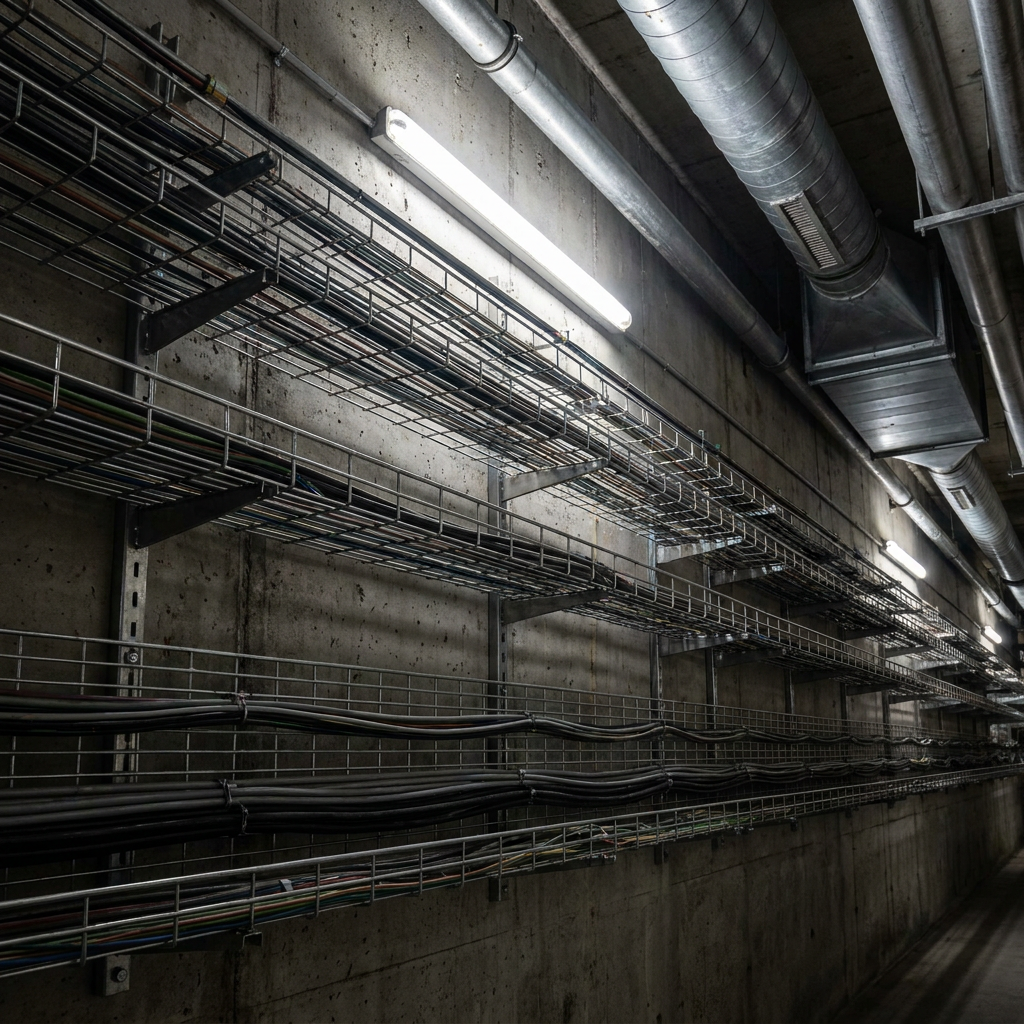
The Physics of Support: Why the Cable Ladder Dominates High-Voltage Sectors The cable ladder is the undisputed heavy-lifter of the industry. Its design—comprising two longitudinal side rails connected by individual rungs—mimics the structural efficiency of an I-beam. This architecture allows the ladder to support massive weight over long spans, often exceeding 6 meters between supports.
In high-voltage applications, such as power plants or heavy manufacturing facilities, the cables used can be as thick as a human arm. A perforated cable tray might buckle under this weight, but the cable ladder thrives. The “open” nature of the ladder also solves the problem of “cable accumulation.” By allowing cables to be tied down to individual rungs, engineers can ensure perfect spacing, which is vital for preventing electromagnetic interference and ensuring that each cable has enough room to “breathe” and dissipate heat.
The Versatility of the Perforated Cable Tray While the ladder handles the heavy power feeds, the perforated cable tray is the workhorse of the instrumentation and control layer. Its continuous bottom provides a solid base for smaller, more fragile cables that might sag or become damaged if left unsupported over the gaps of a ladder. The perforations are not merely for weight reduction; they are precisely engineered to allow for airflow and the drainage of moisture. In outdoor installations, particularly in humid regions like the Philippines or the UAE, preventing water from pooling at the base of the cables is critical for preventing long-term insulation degradation.
Material Science and Longevity: Beyond the Surface For an integrated manufacturer like Qinkai Systems, the science of the material is just as important as the shape of the tray. The selection of the correct finish is a balance between environmental conditions and budget.
- Pre-Galvanized Steel: Best for controlled indoor environments where cost is a primary factor.
- Hot-Dip Galvanized (HDG): The industry standard for outdoor and industrial use, providing a thick, durable coating that heals itself.
- Powder Coating: Used when aesthetic integration or specific chemical resistance is required.
- Stainless Steel: The ultimate solution for longevity in high-salinity or acidic environments.
In the USA and Australia, where labor costs are high, the durability of the cable ladder becomes a financial asset. A system that lasts 50 years without maintenance is significantly cheaper than one that requires replacement after 15 years due to corrosion.
Installation ROI: Speed, Labor, and Modular Design Modern construction schedules are tighter than ever. The development of “Quick-Connect” systems for both cable tray and cable ladder setups has revolutionized the job site. Traditional systems required complex bolting and on-site welding, but modular systems allow for “click-and-lock” assembly.
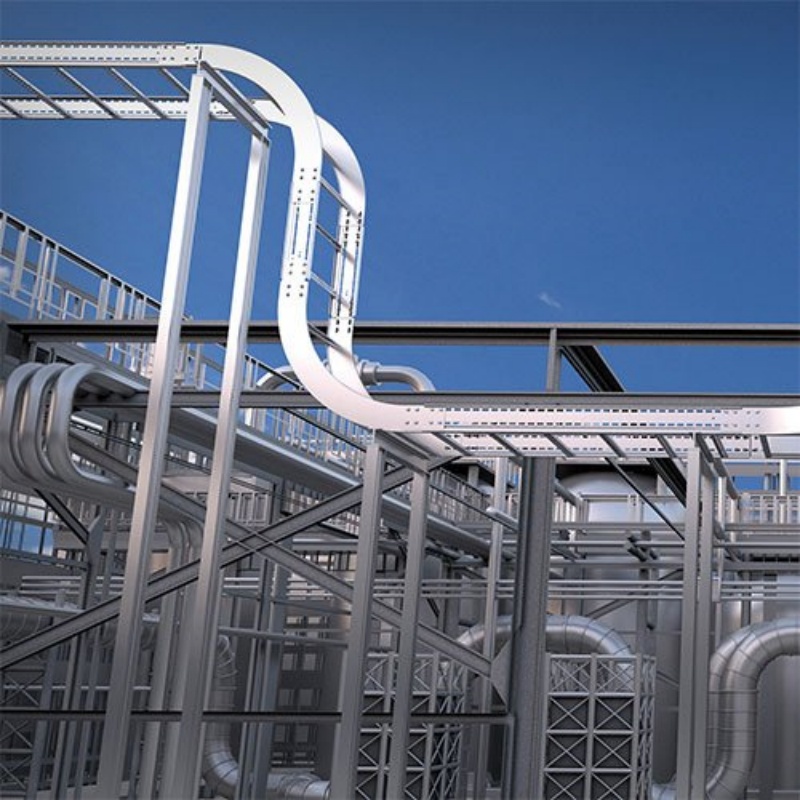
Research suggests that using modular tray systems can reduce installation labor hours by up to 40%. For a large-scale project, such as a solar farm in Saudi Arabia requiring kilometers of cable support, these labor savings can be the difference between a project being under or over budget. Furthermore, the use of specialized accessories—such as internal/elbows, risers, and reducers—ensures that the system can navigate the complex geometry of a modern factory without the need for custom on-site fabrication.
Global Standards and Compliance: NEMA vs. IEC Navigating the global market requires a deep understanding of regulatory compliance. In North America, the National Electrical Manufacturers Association (NEMA) sets the standard for cable tray load ratings and classifications. In Europe and many parts of Asia, the International Electrotechnical Commission (IEC) 61537 standard is the benchmark.
Ensuring that a cable ladder meets these standards is not just about safety; it is about liability. A certified system has undergone rigorous testing for load-bearing capacity, electrical continuity, and flame retardancy. For Sunnie’s customers, providing documented proof of these certifications is the key to winning high-value B2B contracts with government entities and multinational corporations.
Case Study: The Solar Energy Surge The renewable energy sector is currently the fastest-growing consumer of cable tray and cable ladder systems. Solar mounting brackets and fixing kits are only part of the story; the electricity generated by thousands of panels must be funneled back to the grid. These DC cables are often exposed to extreme UV radiation and fluctuating temperatures. A robust, UV-resistant coated cable ladder system is essential for protecting this vital link. In the Australian outback or the deserts of Nevada, the reliability of these support structures is what ensures the world’s transition to clean energy remains uninterrupted.
Summary: The Professional Choice In conclusion, the decision between a cable tray and a cable ladder is an engineering calculation based on load, span, environment, and budget. By mastering the technicalities of both, and offering a range of high-performance materials, Sunnie is positioned as more than a supplier—she is a strategic partner in the global infrastructure boom. As we build the cities and energy grids of tomorrow, the integrity of our cable management systems will remain the true measure of our engineering success.
Post time: May-26-2026