
Persistent Pain Points of Steel Cable Trays in Harsh Working Zones
Construction teams have long suffered from unavoidable defects of metal cable trays in high-corrosion areas. Coastal wind farms, seaside municipal pipe corridors, chemical plants and sewage treatment stations are constantly exposed to salt fog, acid-base fumes and high humidity.
These harsh working conditions erode galvanized steel structures rapidly. Site maintenance records from 12 Southeast Asian offshore wind projects show obvious rust appears on standard steel cable trays within just four years of operation.
Uncontrolled corrosion weakens structural bearing capacity, deforms tray frames and scratches outer cable insulation over time. More critically, conductive steel trays will spread circuit faults once cable leakage occurs, bringing constant safety threats to frontline operation and maintenance workers.
Most project owners previously chose steel trays merely for lower initial procurement costs. Yet they overlooked continuous hidden maintenance fees accumulated during long-term project operation.
Industry cost statistics show metal cable trays need professional rust removal and anti-corrosion repainting every 18 months in corrosive environments. Within a 25-year project cycle, the total maintenance and replacement cost can double the original material investment, creating unnecessary financial burdens for long-term infrastructure projects.
Core Strengths That Make FRP Cable Trays a Better Alternative
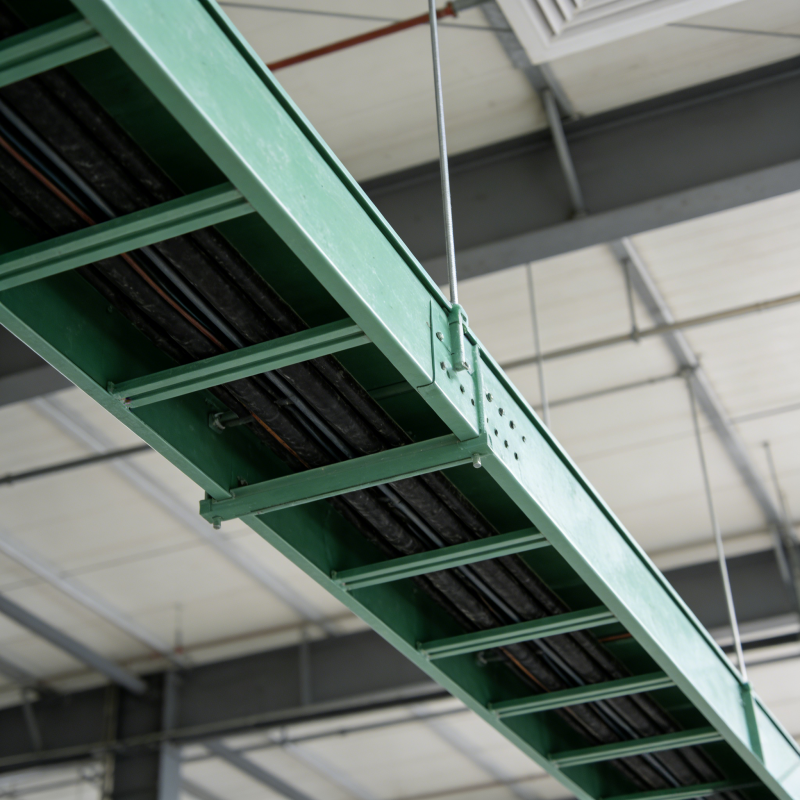
Manufactured via one-piece integral moulding with fiberglass mesh and anti-corrosion vinyl resin, FRP cable trays solve metal material defects fundamentally.
Different from steel trays that rely on surface coatings for corrosion protection, FRP raw materials are naturally inert to acid, alkali, salt mist and most industrial chemical gases. The finished product requires no extra anti-rust treatment and zero routine maintenance after installation.
Field engineering tests prove qualified FRP cable trays can run stably for 28 to 30 years in extreme environments, three times the service life of ordinary hot-dip galvanized steel products.
Two extra practical advantages win wide recognition from global construction contractors. Firstly, its inherent non-conductive property blocks current transmission during cable leakage accidents, limiting circuit faults in small areas and avoiding large-scale power outages.
Secondly, FRP cable trays are extremely lightweight, weighing only one-third of steel trays with the same load-bearing standard. The lightweight design greatly reduces high-altitude installation difficulty and shortens overall project construction period by around 25%.
Booming Market Demand Driven by Global New Energy Construction
Global demand for FRP cable trays is mainly driven by fast-growing offshore wind power, industrial renovation and municipal pipe corridor projects.
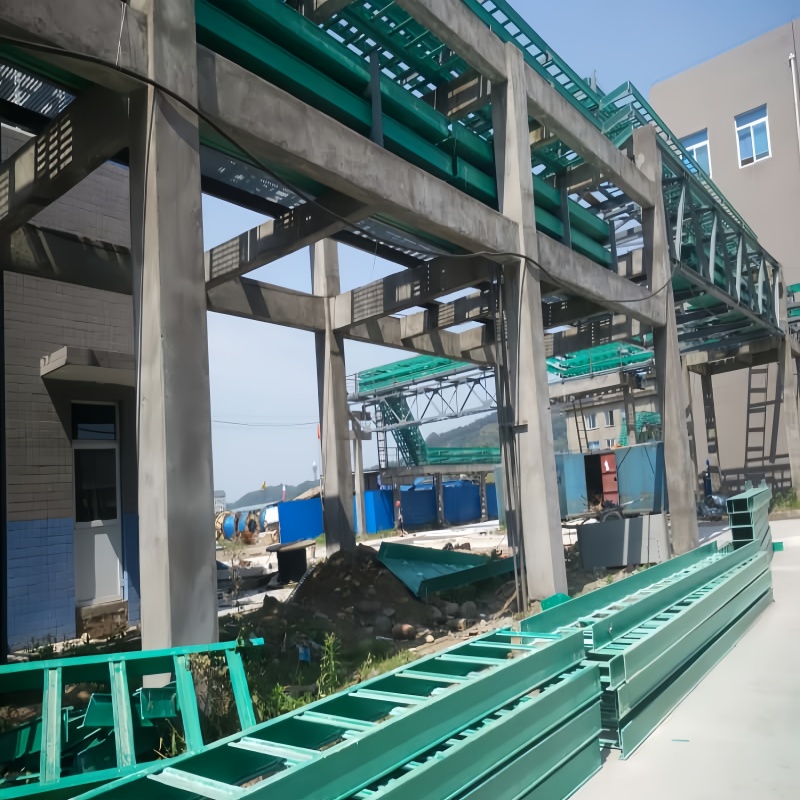
Offshore wind farm construction ranks the top demand source. To achieve carbon neutrality goals, Europe, East Asia and Southeast Asia are accelerating large-scale offshore wind infrastructure layout. The highly corrosive marine environment makes FRP cable trays a mandatory wiring accessory for all offshore electrical systems.
Besides, old industrial park renovation projects in Europe and North America are phasing out aging rusted steel cable trays in batches. All newly built chemical and sewage treatment plants have listed FRP cable trays as standard supporting materials in official construction drawings.
Existing Industry Challenges and Future Development Trends
Despite outstanding performance advantages, FRP cable trays still face bottlenecks restricting further market penetration.
Higher upfront purchase price compared with steel trays remains the biggest barrier, especially for small-scale municipal projects with short service cycles. Meanwhile, unregulated low-end manufacturers cut raw material costs by reducing fiberglass content and adopting inferior resin.
These shoddy FRP products have poor impact resistance and unqualified flame retardant performance, damaging the overall reputation of the whole industry. In addition, the lack of unified global production standards causes minor specification mismatches during cross-border engineering bidding.
Industry analysts hold an optimistic long-term outlook for FRP cable tray development. As more project owners prioritize full-life cycle cost rather than one-time construction expenditure, the economic advantage of maintenance-free FRP products will become more prominent.
Leading manufacturers are also optimizing raw material formulas to narrow the price gap between FRP and steel cable trays. In the future, intelligent FRP cable trays equipped with real-time temperature and leakage monitoring sensors will be launched to match smart grid construction demands.
In the next five years, FRP cable trays will step out of harsh niche scenarios and be widely applied in conventional indoor and outdoor electrical engineering. The material will continue to reshape the global cable management market which has long been dominated by metal products.
Post time: Jun-17-2026