
SHANGHAI, Aug. 28, 2026 — Shanghai Qinkai Industrial Co., Ltd., a manufacturer of NEMA-standard cable tray and cable ladder systems, today launched its T3 hot-dip galvanized cable ladder system, a ladder-type cable support line engineered for high-density power and control cabling in power plants, substations and data centers. The launch comes with a companion installation and application document, released as demand for cable ladders accelerates on the back of AI-driven data center construction and grid modernization programs worldwide.
“We have seen the specification mix change in the past eighteen months,” the company said in a statement. “Projects are asking for heavier cable loads, longer unsupported spans and verifiable test documentation at the quotation stage. The T3 system is our answer — a ventilated, hot-dip galvanized ladder built to NEMA VE 1 and IEC 61537, shipped with load tables and material certificates.”
Why cable ladder demand is accelerating in 2026
The numbers behind the timing are stark. The global data center cable ladder market reached USD 1.075 billion in 2025 and is projected to grow to USD 2.075 billion by 2032, a CAGR of 9.85 percent, according to PW Consulting’s market analysis. In 2026 alone the segment is set to rise to USD 1.199 billion, an 11.5 percent year-on-year increase — the strongest growth in the ladder market’s recent history.
Hyperscale data centers are the engine: they captured nearly 54 percent of global cable ladder revenues in 2025. Enterprise data centers followed with 30.2 percent and colocation facilities with 16 percent. Across the wider market, IndexBox projects a 4.2 percent compound annual growth rate for global cable ladders over 2026–2035, anchored in the concurrent expansion of energy transition projects, hyperscale data center construction and modernization of public and industrial utilities.
The demand structure tells the same story. Industrial power distribution accounts for an estimated 28 percent of cable ladder demand, data center cabling 22 percent, commercial building wiring 20 percent, transportation systems 15 percent, and renewable energy projects 15 percent — the latter flagged as the fastest-growing end-use segment through 2035, driven by solar and wind buildout.
Why AI workloads are rewriting ladder specifications
The shift is not just about volume; it is about specification. AI workloads drive higher cable densities per rack, and operators are demanding ladders with superior airflow management, higher load ratings and easier access for maintenance. Three specification trends stand out in 2026:
Ventilated, high-capacity designs. Rungs engineered for heat dissipation and secure cable lashing are displacing older solid-rung products in server halls and power rooms, where thermal management decides system life.
Corrosion-rated materials as standard. Hot-dip galvanized steel remains the workhorse for outdoor and industrial atmospheres, while lightweight aluminum ladders are winning specification in data center grey space for their non-magnetic properties and ease of overhead installation.
Compliance as a procurement gate. Data center projects increasingly require NEMA VE 1 compliance for metal cable tray systems and NEC Article 392 installation practices, alongside fire-rated and test-documented products. Suppliers that cannot document compliance are being filtered out at the design stage.
What the T3 system brings to the market
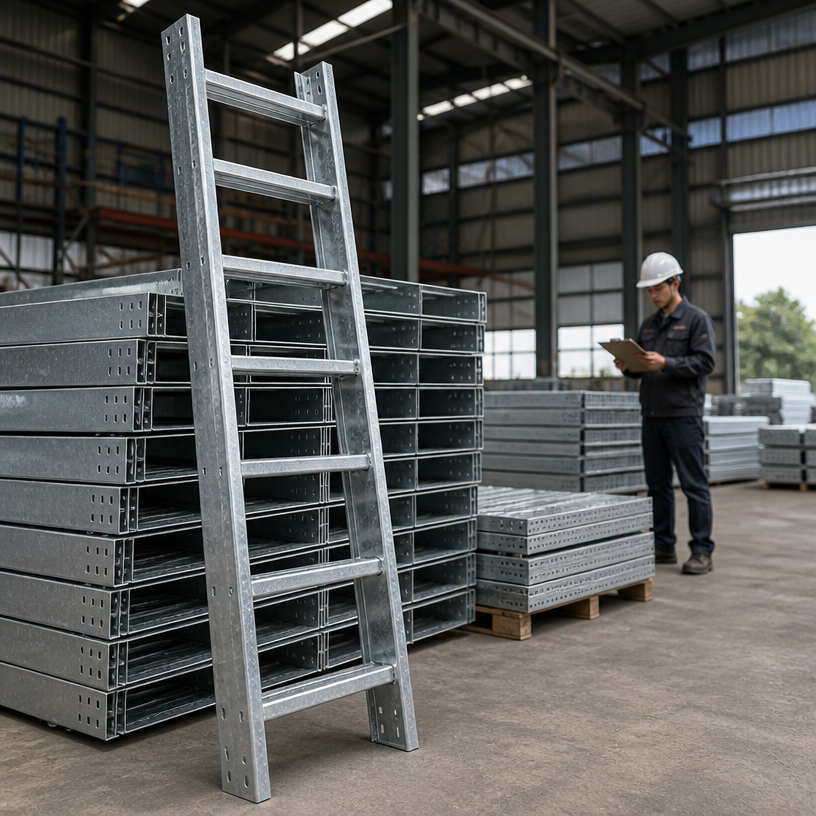
The T3 is a ladder-type cable tray built for the toughest industrial environments: thermal and gas power plants, substations and switchyards, oil and gas facilities, wastewater treatment plants, heavy manufacturing and data center power distribution. Its construction follows the engineering logic of heavy-cable support:
C-profile side rails with an inward-facing channel that acts as a built-in cable guide, resisting bending and twisting under load while keeping the outer face clean for mounting.
Seven-slot ventilated rungs, resistance-welded hollow sections that dissipate heat from energized cables, reduce dead weight and provide 360-degree cable lashing points at every rung.
Hot-dip galvanized finish to EN ISO 1461, with typical coating thickness of 70–85 µm — three to five times thicker than electro-galvanized alternatives — plus cathodic self-healing protection at scratches and cut edges.
Pre-punched oval splice holes at both ends of each side rail, so sections bolt together in the field with splice plates and standard hardware — no drilling, no welding, no special tools.
Full fittings range — horizontal and vertical bends, tees, crosses, reducers and drop-out units — manufactured in-house so a complete run is sourced from a single supplier, with one drawing and one responsible party.
T3 sections ship in standard 3 m and 6 m lengths in widths from 200 mm to 900 mm, with rung pitch options of 250 mm and 300 mm. Load ratings follow NEMA VE 1 / IEC 61537 test methods with published load tables per width, rung pitch and support spacing, applying a 1.5 safety factor.
Installation and application guidance
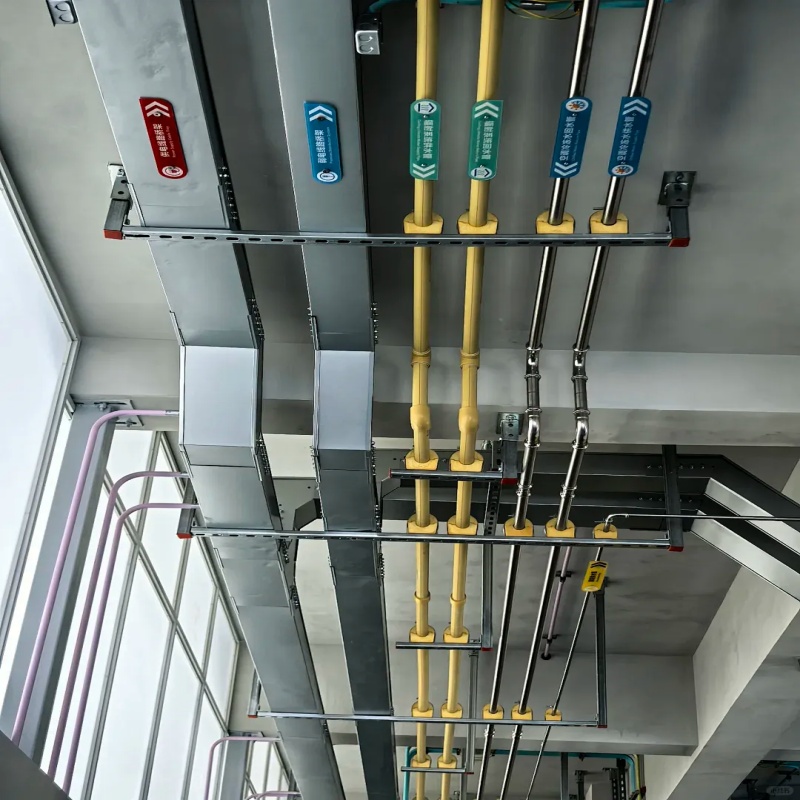
The companion document covers the full field workflow: route planning from layout drawings; support installation at design spacing — ceiling rod suspension, wall brackets, floor stands or strut supports, typically 1.5–2.5 m for standard loads; bolted section splicing; fittings installation; cable laying and lashing through the rung ventilation slots; and termination with bonding and grounding per local electrical code. A dedicated section addresses outdoor and corrosive-atmosphere installation, where cut ends are touched up with zinc-rich paint and the galvanized coating’s cathodic protection maintains integrity over decades of service.
Market context and outlook
The launch lands in a competitive market where tier-one suppliers are moving on the same signals: prefabricated, code-documented ladder systems, modular fittings that cut installation time, and fire-tested designs for data center grey space. Qinkai said it will follow the T3 launch with expanded stainless steel and aluminum ladder options for coastal and clean-manufacturing applications, and will continue shipping full engineering documentation — load tables, EN ISO 1461 coating reports and mill certificates — with every project order.
“The market is no longer buying cable ladder by the meter,” the company said. “Buyers are purchasing a documented support system with predictable load performance and predictable installation cost. That is exactly what the T3 delivers.”
About Shanghai Qinkai Industrial Co., Ltd.
Shanghai Qinkai Industrial Co., Ltd. is a manufacturer and exporter of NEMA-standard cable tray and cable ladder systems, seismic supports, solar mounting structures, LED aluminum profiles and architectural track systems, and custom steel hardware. The company serves EPC contractors, distributors, and infrastructure developers across North America, Latin America, the Caribbean, South Asia, and Southeast Asia. All products are manufactured in China and shipped with full material certificates and project documentation.
Post time: Aug-28-2026