
A cable ladder looks like the simplest item on a procurement list: two rails, rungs at 300 mm, a length, a finish. It is also the item that most often reaches site with a load number that nobody re-checks against the way it is actually supported.
That mismatch is drawing more attention this year as buyers working across markets reconcile two frameworks at once. The International Electrotechnical Commission published the third edition of IEC 61537, the international standard for cable tray and cable ladder systems, replacing the 2007 edition. In North America, projects still specify to NEMA VE-1, and installation still follows NEMA VE-2. Two systems, one delivered product, and a specification sheet that frequently quotes only one of them.
What VE-1 actually classifies
NEMA VE-1 classifies cable tray and cable ladder by load-carrying capability, expressed through class designations that correspond to a span and a uniformly distributed load. The designation is derived from testing, not from geometry. Two ladders with identical 146 mm side rails and 2.0 mm steel can sit in different classes if their rung detail, rail profile or splice arrangement differs.
This is the first place buyers lose margin. A supplier quoting a class is quoting a test outcome. Unless the test report, the span and the support condition travel with the quotation, the number is a claim without a boundary.
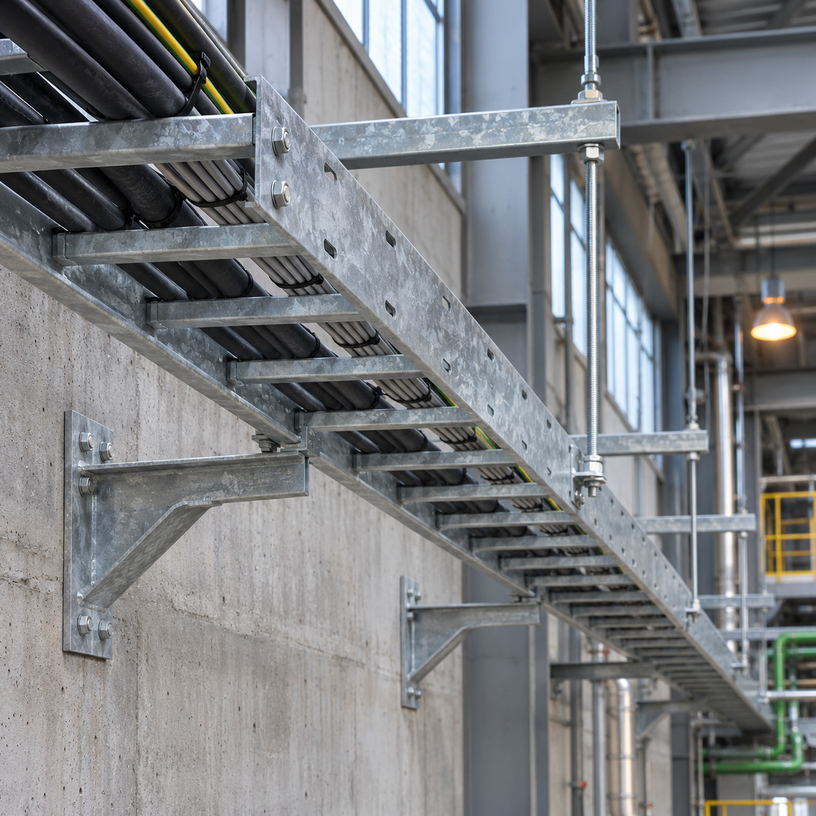
Safety factor is stated, not implied
Well-run manufacturers publish the basis of their data. In the catalogue pages used for this analysis, load and deflection figures are given as single-span results described as the worst case, with a safety factor of 1.5 over collapse load, and deflections tabulated on continuous spans. The detail that matters: for single-span installation, deflection must be multiplied by 2.5.
That single line changes designs. A run tabulated at 18 mm of sag becomes 45 mm once it is supported at two points only, which is common at penetrations, at the end of a run, or where a trapeze hanger cannot be fixed. Deflection is not a cosmetic issue. It changes cable bend radius, it loads the splice plates, and it alters the elevation of every tray downstream.
Test provenance is checkable, and it is worth checking. One supplier catalogue reviewed for this article states that its load and deflection data come from a laboratory operating under NATA accreditation, and that tested ladders exceed the class designation applied to them. That sentence is more useful than a bare number, because it names the testing environment and the direction of the margin.
Span and support spacing do more work than class
Support spacing decides the class as much as the steel does. A 6 m ladder carrying 150 kg/m at 3 m support spacing is a different structure from the same ladder at 6 m spacing, where published data for that profile falls to roughly a quarter of the short-span figure. Buyers who compare quotations by the headline load number alone are comparing two different structures and calling it a price comparison.
The practical rule used by specifying engineers: fix the support spacing first, then read the load table at that spacing, then check deflection against the cable manufacturer’s bend radius. Class follows from those three decisions; it does not lead them.
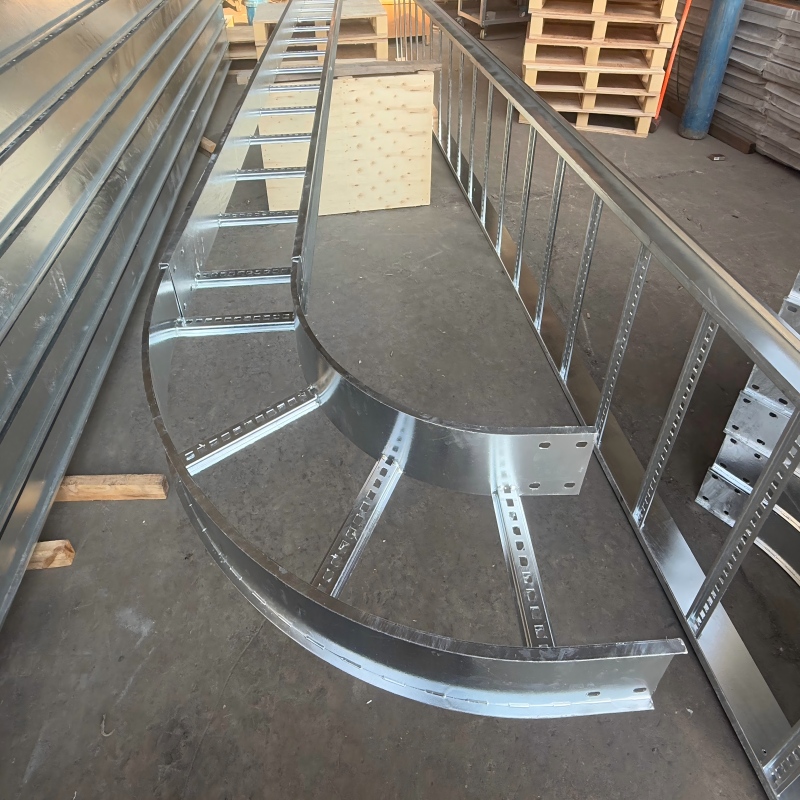
Surface treatment is a design decision, not a line item
Cable ladder for industrial work is normally supplied in one of three finishes: hot-dip galvanized after fabrication, 316 stainless steel, or powder coating. The distinction that gets lost in quotation comparison is when the zinc is applied.
Hot-dip galvanizing after welding seals the weld zone and the cut ends, which is where corrosion starts on a welded ladder. Steel that is galvanized before fabrication leaves bare metal at every weld and drill point; on a ladder with hundreds of rung welds per length, the exposed area is not trivial. Where a project specifies hot-dip galvanizing, the specification is a process requirement, not a colour.
316 stainless is not a coating. Selecting it replaces the base material, so there is no zinc layer and no coating thickness to certify, and the corrosion argument moves to grade, passivation and chloride exposure.
Powder coating raises a question buyers rarely ask: coated over bare steel, or over galvanized steel? The two behave differently in salt spray, and only one of them survives a scratched surface in a coastal plant.
Order codes deserve the same scrutiny. Finish is normally carried as a letter inside the product code, and the same letter does not always mean the same process across one catalogue: powder coating appears as PC on some series pages and as P on another page of the same document. On a project with several hundred line items, that single inconsistency becomes a delivery in the wrong finish.
Where the standard stops
The most common compliance error in this category is linguistic. NEMA publishes standards; it does not certify products. A listing that reads “NEMA certified” is describing something that does not exist. The defensible phrasing is “manufactured to NEMA VE-1″ or “designed to NEMA VE-1″, supported by a test report that names the span, the load and the support condition.
This is not a technicality. Where a submittal reaches an engineer of record with a certification claim that cannot be substantiated, the review stops, and the whole package goes back.
A five-question check
Buyers can test any quotation in five questions. What span produced this load figure? Was the deflection measured on a continuous or a single span? What is the steel thickness and the rung spacing behind the class? Which finish, applied at which stage of fabrication? And which document supports the number — a test report, or a catalogue line?
A supplier who answers all five in one email is selling an engineering product. A supplier who answers only the price is selling steel.
That distinction will matter more as more projects carry two standard references on the same drawing. The product has not changed. The documentation has to.
Post time: Nov-04-2026