Australia NEMA Cable Ladder for Heavy Cable Runs


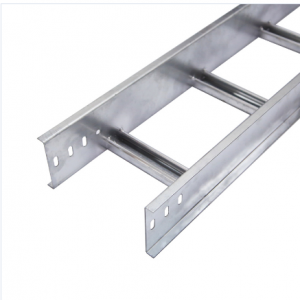
Ladder-type cable tray: two formed steel side rails, rungs fixed at standard centres, splice plates at each end. Straight sections and fittings are supplied as one system, so the run arrives complete rather than as tray plus a separate accessory order.
Open rung design — cables sit on rungs, air moves through the bundle, and cable can be dropped in or lifted out at any point along the run.
Hot-dip galvanised after fabrication — zinc covers cut ends, punched holes and welds, not only the flat faces.
Rigid section — the rung-and-rail construction carries load over longer spans, so fewer intermediate supports are needed.
Fittings made to the layout — bends, tees, crosses, reducers and risers are produced to the route drawing instead of being adapted on site.

Construction and finish

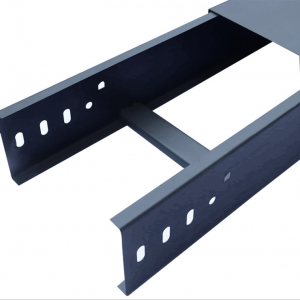
Side rails are cold-formed with a returned edge, which stiffens the section without adding gauge. Rungs are welded between the rails at a fixed pitch and checked for square before the length leaves the jig. Holes for splice plates, hanger brackets and hold-down clamps are punched, not drilled, so they line up from one length to the next.
Pre-galvanized sheet is cut and formed first, then the cut edges are the only uncoated faces — adequate indoors and in dry plant rooms. Hot-dip galvanizing after fabrication coats the welds and cut edges as well, which is what outdoor and washdown areas need. Stainless is supplied unpainted for food, marine and chemical environments.
Why this ladder gets specified
◉ Open rungs, no lid — Lay cable in from above. No threading through a closed tray and no cover to remove when a circuit changes.
◉ Spacing set by your load case — Rungs span between hangers, so support spacing follows your engineer's load calculation rather than the tray width.
◉ Heat has somewhere to go — Open structure keeps bundled cables cooler than a closed tray, which matters on long power runs.
◉ One system through to the fittings — Bends, tees, crosses, reducers and splice plates share the straight length profile, so the run closes without field fabrication.
Specification
|
12A |
16A |
20B |
20C |
|
|
Duty (catalogue) |
Light duty |
Medium duty |
Heavy duty |
Medium duty |
|
Material thickness |
1.6 mm |
1.6 mm |
2.0 mm |
2.0 mm |
|
Side rail height |
67 mm |
93 mm |
130 mm |
146 mm |
|
Cable laying depth |
48 mm |
74 mm |
111 mm |
127 mm |
|
Standard length |
4 m |
5 m |
6 m |
6 m |
|
Nominal rung spacing |
300 mm |
300 mm |
300 mm |
300 mm |
|
Splice plates |
Tapped, no drilling |
4 bolt |
8 bolt |
8 bolt |
|
Standard radius fittings |
300 mm |
450 mm |
450 mm |
600 mm |
|
Rail direction |
Rail-In / Rail-Out |
Rail-In / Rail-Out |
Rail-In / Rail-Out |
Rail-In / Rail-Out |
|
Common to all four series |
Detail |
|
Widths |
150 / 300 / 450 / 600 / 900 mm |
|
Product code |
N + series + width + rail direction + finish, e.g. N20C60ROH |
|
Finishes |
Hot-dip galvanized · 316 grade stainless steel · Powder coated |
|
Covers |
Flat and peaked covers, 2.4 m straights, full range of flat fitting covers |
|
Design standard |
NEMA VE 1-2009 |
|
Safety factor |
1.5 over collapse load |
If you need know more about NEMA Cable Ladder. Welcome to visit our factory or send us enquiry.
Detail Image

NEMA Cable Ladder One Way Package
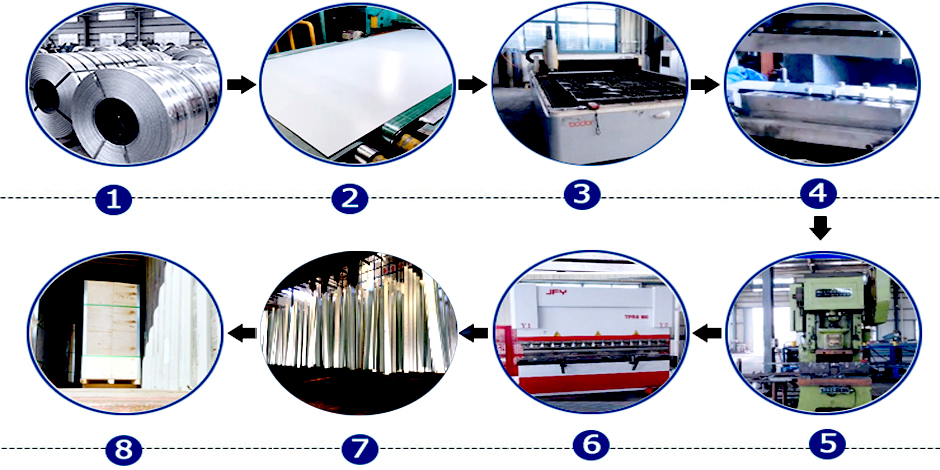
Perforated Cable Tray Process Flow
NEMA Cable Ladder Packaging