
Few industrial products are as unglamorous — or as indispensable — as cable tray. The metal frames that carry power and data cables through substations, factories, data centres and transit tunnels almost never make headlines. But the forces reshaping global infrastructure in 2026 have made cable tray and cable ladder one of the fastest-moving segments in electrical distribution, and the numbers now justify the attention.
According to Fortune Business Insights, the global cable tray market was valued at USD 6.41 billion in 2025 and is projected to grow to USD 7.34 billion in 2026, reaching USD 16.14 billion by 2034 — a compound annual growth rate of 10.35 percent. Ladder-type tray is the dominant format, forecast to account for 69.51 percent of the market in 2026, and aluminium is expected to lead by material with a 75.88 percent share. Asia Pacific already commands 40.02 percent of global demand, valued at USD 2.57 billion in 2025.
None of this is happening by accident. Three structural forces are colliding at once: an AI-driven data centre buildout with no historical precedent, the largest grid modernization cycle in a generation, and a supply side still digesting tariff shocks and metal price volatility.
Demand engine one: the data centre buildout
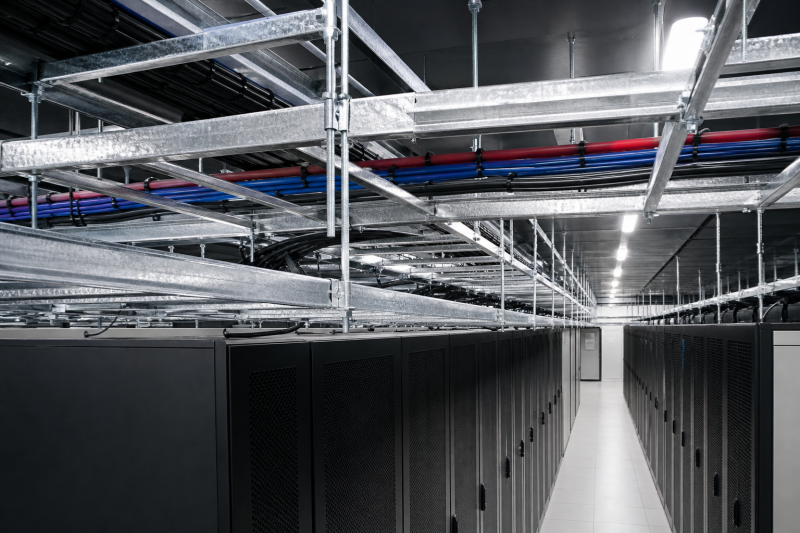
Data centres are the fastest-growing buyer of cable support systems. The global data centre cable ladder market reached USD 1.075 billion in 2025 and is projected to climb to USD 2.075 billion by 2032 at a 9.85 percent CAGR, according to PW Consulting. Hyperscale facilities alone captured nearly 54 percent of 2025 revenues. Global data centre capacity is expected to double between 2026 and 2030, and AI workloads — which are dramatically more cable-intensive per rack than traditional computing — are projected to rise from 54 percent of global data centre capacity demand to around 70 percent by 2030, per McKinsey analysis.
The specification consequences are concrete. Operators are demanding ladders with higher load ratings, better airflow management for heat dissipation, and easier access for maintenance. Welded ladder construction held 63.5 percent of the data centre segment in 2025 on the strength of structural integrity in high-density halls. Manufacturers are racing to answer: Eaton is promoting its B-Line 3-in-1 universal fitting to cut installation time, Legrand launched a pre-galvanised, fire-tested ladder aimed at data centre grey space, and Snake Tray has released a prefabricated tray catalogue to compress construction schedules.
Demand engine two: grid modernization and renewables
The second engine is electricity infrastructure itself. Cable tray demand splits across industrial power distribution (an estimated 28 percent), data centre cabling (22 percent), commercial building wiring (20 percent), transportation systems (15 percent) and renewable energy projects (15 percent), according to IndexBox. The renewable share is flagged as the fastest-growing through 2035: solar farms and wind installations are cable-heavy by design, and offshore wind in particular consumes vast quantities of corrosion-rated tray and ladder.
Grid modernization adds a layer on top. Utilities retiring ageing coal generation and integrating distributed renewables are rebuilding substations and transmission corridors on timelines that overlap the data centre boom. Australia’s case is instructive: data centres there now account for 2 percent of grid-supplied energy, projected to reach 6 percent by 2030, while sector investment into grid infrastructure is projected to hit A$7.2 billion by 2030 — simultaneous demand for more generation, more transmission and more cable support in both.
The supply side is still digesting shocks
Demand is running ahead of supply-side stability. Steel and aluminium price volatility is squeezing manufacturers — raw materials affect roughly 20 percent of production costs in the data centre ladder segment, and pricing for the broader market remains closely tied to underlying metals markets. In the United States, Section 232 tariffs on imported steel and aluminium pushed cable management product costs up by as much as 50 percent in 2025, according to sector analysis, reinforcing procurement strategies that favor documented quality over the lowest unit price.
The response is regionalization. New production capacity is coming online outside traditional hubs — including a ladder and tray plant opened in Greater Noida, India in 2025 to serve regional projects — and buyers are increasingly willing to pay for reliability and compliance rather than shifting specification risk to site. IndexBox notes the market will remain fragmented, with competition driven by product specification, compliance with regional safety standards (IEC, NEC) and distribution reach rather than price alone.
Compliance has become the procurement gate
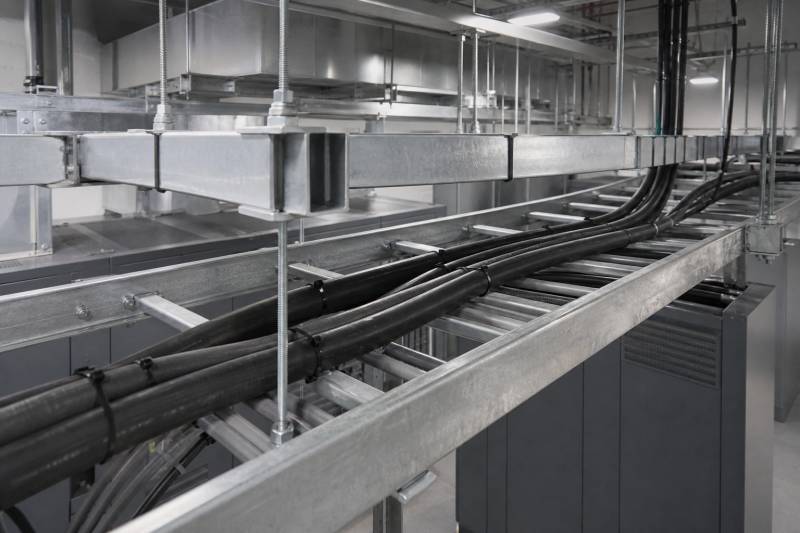
The most visible change in 2026 specification documents is the compliance wall. Data centre projects in North America now routinely require NEMA VE 1 compliance for metal cable tray systems and NEC Article 392 installation practices. In Europe and export markets, IEC 61537 test requirements — including marking and load-class documentation — are becoming standard. Australian installations reference the AS/NZS 3000 wiring rules alongside IEC 61537-based test criteria.
The practical effect is that suppliers without test documentation, load tables and material certificates are filtered out at the design stage. This favors manufacturers who control the full production chain — extrusion, fabrication, galvanizing, testing — and can issue engineering documentation with every shipment. It also explains why “documented support system” has replaced “cheapest per meter” as the working procurement language in project tenders.
A fragmented field, with Chinese manufacturers pushing up-market
The competitive landscape remains dispersed: Atkore, ABB, Eaton, Legrand, OBO Bettermann, MP Husky, Snake Tray and nVent lead specification in Western markets, while regional producers hold share in their home territories. But the compliance wall is opening space for exporters who can document performance. Shanghai Qinkai Industrial, a Shanghai-based manufacturer of NEMA-standard tray, ladder and seismic support systems, said it has seen load tables and material certificates arrive at the RFQ stage rather than after the order across its export markets, and has built its T3 hot-dip galvanized ladder line around EN ISO 1461 coating documentation, IEC 61537 test data and a complete in-house fittings range.
“Buyers are no longer comparing prices; they are comparing documentation packages,” a company representative said. “The product that ships with the thickest engineering file is the product that wins the specification.”
What to watch through 2034
Three trajectories are worth tracking. First, the data centre segment will keep outgrowing the market: at 9.85 percent CAGR it roughly doubles by 2032, and every gigawatt of new compute capacity pulls ladder, tray and support systems behind it. Second, the material mix is shifting — aluminium’s dominance reflects lightweight, corrosion-resistant and non-magnetic properties that suit overhead data centre runs and solar farms alike, while hot-dip galvanized steel remains the workhorse for outdoor and industrial atmospheres. Third, wire mesh tray is the fastest-growing product type, favored in data centres for ventilation and speed of installation, which will keep competitive pressure on ladder manufacturers to justify their premium with load performance.
The industry’s quiet era is over. Cable tray is no longer a commodity line item in electrical distribution — it is a measured, documented, specification-critical component of the digital and energy transition, and it is now big enough to be seen.
Post time: Sep-01-2026