
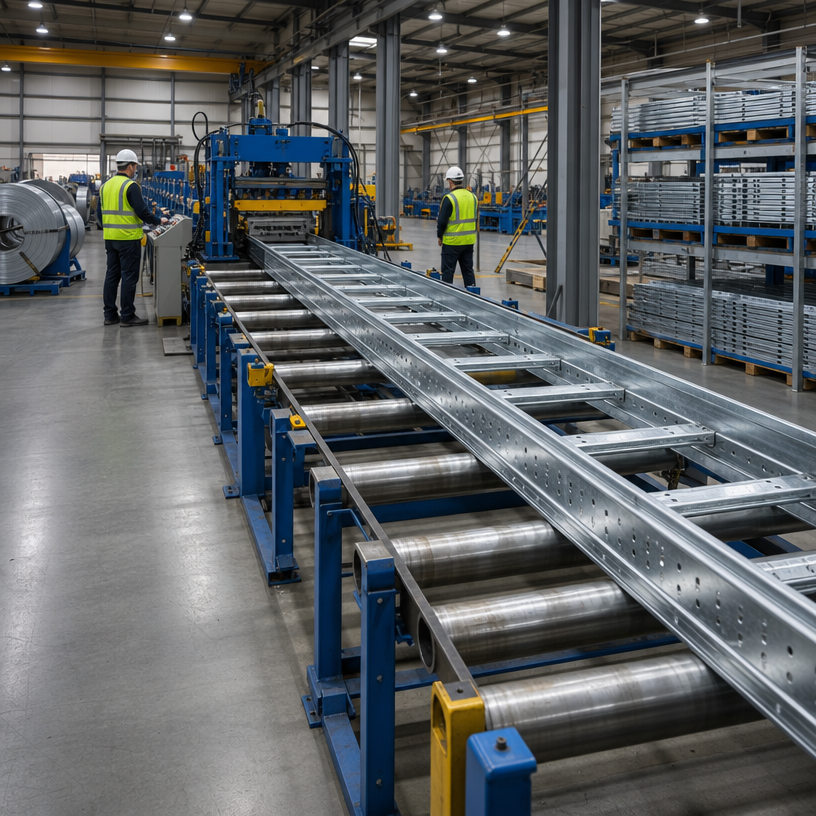
SHANGHAI, Aug. 20, 2026 — Shanghai Qinkai Industrial Co., Ltd., a manufacturer of cable tray and cable ladder systems, seismic supports, and solar mounting structures, today announced the completion of an expanded production line for NEMA VE-1 compliant cable tray systems, a move the company says will cut lead times for EPC (engineering, procurement, and construction) buyers in the United States, Canada, and Latin America from six weeks to under three.
The expansion adds two automated roll-forming lines with a combined annual capacity of 8,000 metric tons, bringing the company’s total cable tray output to more than 15,000 metric tons per year. The new lines produce cable ladder, perforated tray, and solid-bottom tray in hot-dip galvanized steel, stainless steel, and aluminum, covering the full range of corrosion classes specified in industrial and infrastructure projects.
“The timing is driven by our order book, not by optimism,” said company operations director Lucas Liu in a statement. “North American EPC contractors are specifying cable tray earlier in the design cycle, and they are asking for NEMA test documentation and material traceability at the quotation stage. We built this line to answer exactly that.”
Why cable tray demand is accelerating
The expansion comes as global demand for cable management systems continues to rise, fueled by grid modernization programs, data center construction, and large-scale transit projects. Cable tray systems are widely preferred over conduit in these segments because they allow high cable densities, faster installation, and unobstructed access for inspection and future circuit additions.
Industry observers note that buyers in the Americas are increasingly standardizing on NEMA VE-1 for structural testing and load ratings, and NEMA VE-2 for installation practice. Suppliers that can document compliance across both standards, with load tables and material certificates for every shipment, are winning specification battles against competitors offering uncertified imported product.
What the new line produces
The expanded facility manufactures the three workhorse tray categories used in power and industrial projects:
- Cable ladder for heavy power cables, with rung spacing engineered for natural sag control and heat dissipation in continuous-duty applications
- Perforated (ventilated) tray for mixed power and control runs, balancing airflow with moderate shielding
- Solid-bottom tray for sensitive signal circuits and dust-prone environments
All tray sections are available in hot-dip galvanized steel with zinc coating per ASTM A123, Type 304 and Type 316 stainless steel for coastal and chemical environments, and aluminum where weight reduction is critical for seismic or rooftop applications. Fittings, couplers, covers, and divider systems are manufactured in-house to ensure dimensional consistency across complete runs.
The company also confirmed that its seismic support (抗震支架) line, which integrates with cable tray runs for transverse and longitudinal bracing, will ship in parallel with tray orders for projects in seismic zones, including much of the Caribbean, the Philippines, and the western United States.
New installation SOP issued with NEMA VE-2 alignment
Alongside the production expansion, Qinkai announced the issuance of SOP-CAB-001: Cable Tray Installation, Inspection and Maintenance — NEMA VE-2 Compliant Work Procedure, a seven-step standard covering pre-installation verification, support installation, tray assembly, cable laying, bonding and grounding, inspection and handover, and periodic maintenance.
The procedure specifies support spacing, fastener torque values, cable fill margins, and bonding continuity testing per NEC 392.60. The company says the SOP is provided free to customers as a project document, addressing a recurring pain point for contractors who receive tray material without installation guidance aligned to North American code requirements.
“We kept seeing the same failure mode on sites: a correctly specified tray system installed with the wrong support spacing or skipped bonding,” Liu said. “The SOP is not marketing collateral. It is the same document our own quality team uses, and it is attached to every export shipment that needs it.”
Quality control and testing
Every tray section leaving the new line undergoes dimensional inspection, zinc coating thickness measurement, and load verification against the published class rating before packing. Material certificates are issued per heat for steel members, and galvanizing certificates document coating thickness per ASTM A123. For projects with third-party inspection requirements, Qinkai said it accommodates factory acceptance testing and witness inspections at the customer’s request.
The company maintains a laboratory equipped for coating thickness testing and dimensional verification of fittings, couplers, and supports, ensuring that complete runs — not just straight sections — meet the tolerances specified in the project drawings. This focus on system-level consistency, rather than component-level pricing, is a growing differentiator in a market where imported tray is often sold without verifiable test data.
Export milestones and market focus
The expansion follows a period of rapid export growth. Qinkai reported that shipments to the United States, Canada, Pakistan, the Philippines, Bangladesh, and Latin American markets — including Peru, Panama, and the Caribbean — increased by more than 60 percent year over year in the first half of 2026. High-value orders for seismic-braced cable ladder systems and stainless steel tray for coastal installations were cited as the fastest-growing segments.
The company’s order pipeline currently includes cable tray systems destined for power plant balance-of-plant packages, airport and transit infrastructure, and industrial facility expansions, with a growing share of orders quoting NEMA VE-1 class ratings and seismic bracing requirements at the RFQ stage.
Looking ahead
Qinkai said the new capacity will be directed first at reducing lead times for existing North American and Latin American customers, with additional investment planned in factory testing equipment to support third-party load verification on site. The company is also expanding its documentation team to accelerate turnaround of NEMA compliance dossiers, material certificates, and project-specific load calculations.
“EPC buyers do not buy cable tray by the meter; they buy a deliverable with documentation,” Liu said. “Our goal is to make the documentation as reliable as the steel.”
Post time: Aug-20-2026