
The marine infrastructure boom of the 2020s is easy to see from the waterline: new quay cranes rising above container terminals, offshore substation topsides moving out of fabrication yards, turbine blades stacked at staging ports. What is invisible from the waterline is the electrical system that makes every one of these assets work — and the miles of cable tray and cable ladder that carry its power, control and instrumentation circuits through salt-laden air.
The numbers explain why that invisible layer now matters more than ever. The global offshore wind market was valued at USD 42.3 billion in 2025 and is projected to grow from USD 45.2 billion in 2026 to USD 93.5 billion by 2033, a 10.9 percent CAGR, according to Grand View Research. The port electrification market is set to grow from USD 3.1 billion in 2026 to USD 4.64 billion by 2030 at a 10.6 percent CAGR, and shore power — the systems that let berthed ships switch off their diesel engines — is projected to climb from USD 1.57 billion to USD 2.75 billion by 2033. RenewableUK estimates around 236 GW of offshore wind fully operational by the end of 2030.
Every one of those dollars ends up, in part, inside an electrical distribution system specified for the harshest atmospheric conditions in the built environment. Cable tray is the quiet backbone of that system.
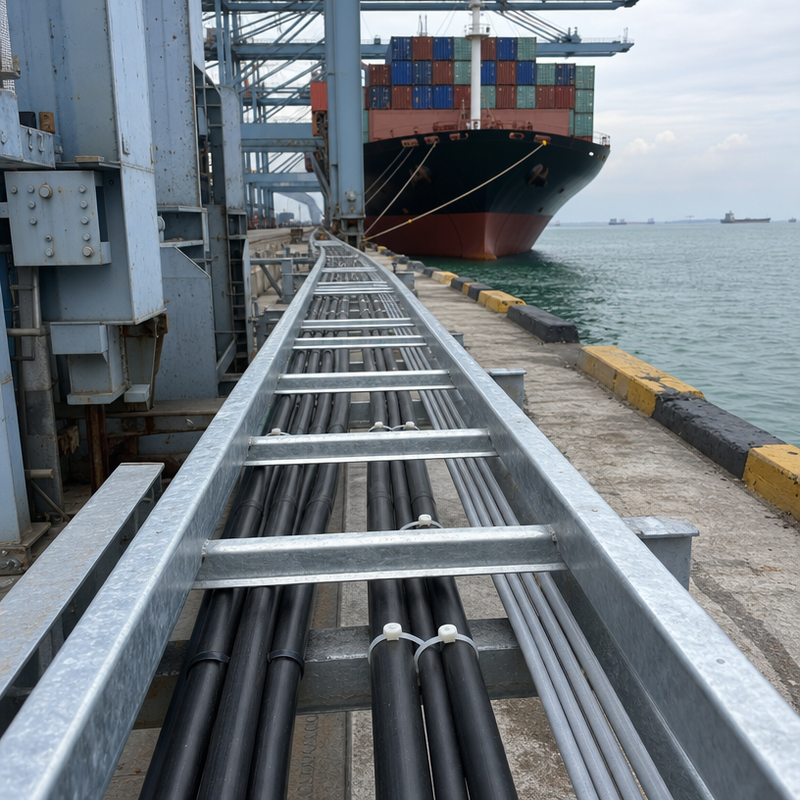
Why marine infrastructure treats cable support as critical
The engineering community learned long ago that coastal and offshore environments are a different specification universe. Marine atmospheres sit at the top of the ISO 12944 corrosivity scale — C5-M for high-salinity coastal and offshore zones — where airborne salt, cyclic wetting and chloride stress attack unprotected steel far faster than any inland pollutant. For infrastructure owners whose assets carry 25-year design lives, this changes cable support from a commodity line item into a corrosion-strategy decision with documented consequences.
The regulatory layer reinforces it. IEC 61537 governs test and marking requirements for cable tray and ladder systems, EN ISO 1461 and ASTM A123 define hot-dip galvanized coating performance, and classification societies such as DNV, ABS and Lloyd’s Register apply their own rules to floating and vessel-borne installations. Increasingly, marine infrastructure projects require all of these to be evidenced per shipment: material certificates, coating thickness reports and published load tables arrive with the material, not after it.
Port electrification: the retrofit challenge
Ports are where marine infrastructure’s electrical complexity is growing fastest. Container terminals are electrifying their gantry cranes and rubber-tyred equipment, refrigerated container zones are drawing more power than ever, and shore power installations are connecting berthed vessels — cruise ships, container carriers and bulkers — to grid electricity. The U.S. Federal Maritime Administration’s port infrastructure programs, Europe’s maritime investment cycle and Asia’s expanding hub ports are all pushing the same direction: electrification at scale, on sites that were never designed for it.
The retrofit reality makes cable management the critical path. Existing terminals route new medium-voltage feeders, transformer feeds and control networks through congested corridors — under quays, along wharf edges, through substation extensions — where cable ladder systems must be suspended above salt spray, in tidal zones and along vibration-heavy crane gantries. Hot-dip galvanized ladder and tray systems per EN ISO 1461 dominate this segment: they deliver the required service life at a fraction of stainless steel’s cost, provided fittings carry the same coating specification as straight sections and field-cut ends receive zinc-rich repair treatment. Single-source supply matters acutely here, because a mixed-vendor run with inconsistent coating quality fails first at its interfaces.
Offshore wind: specification borrowed from oil and gas
Offshore wind extends the same rules offshore, where the assets are unmanned and maintenance windows are measured in weather windows rather than work days. Fixed-bottom installations — monopiles, jackets and gravity-based structures — accounted for 74.4 percent of the market in 2025, and each turbine, transition piece and offshore substation carries a full electrical package: medium-voltage array cables, power export circuits, control and SCADA systems.
Inside a nacelle or an offshore substation topside, cable support must survive continuous vibration, confined routing and the same C5-M atmosphere as an oil and gas platform. That is why the industry’s specification has converged on oil-and-gas-grade practice: stainless steel cable support in nacelle, transition piece and substation areas where access is difficult, hot-dip galvanized systems in less exposed locations, and complete, documented fittings ranges so that routes can be installed and modified without specialized fabrication offshore. As wind farms move into deeper water and floating platforms enter the pipeline, operators are applying these grades with increasing rigor — a quiet but consistent upgrade of the sector’s cable management baseline.
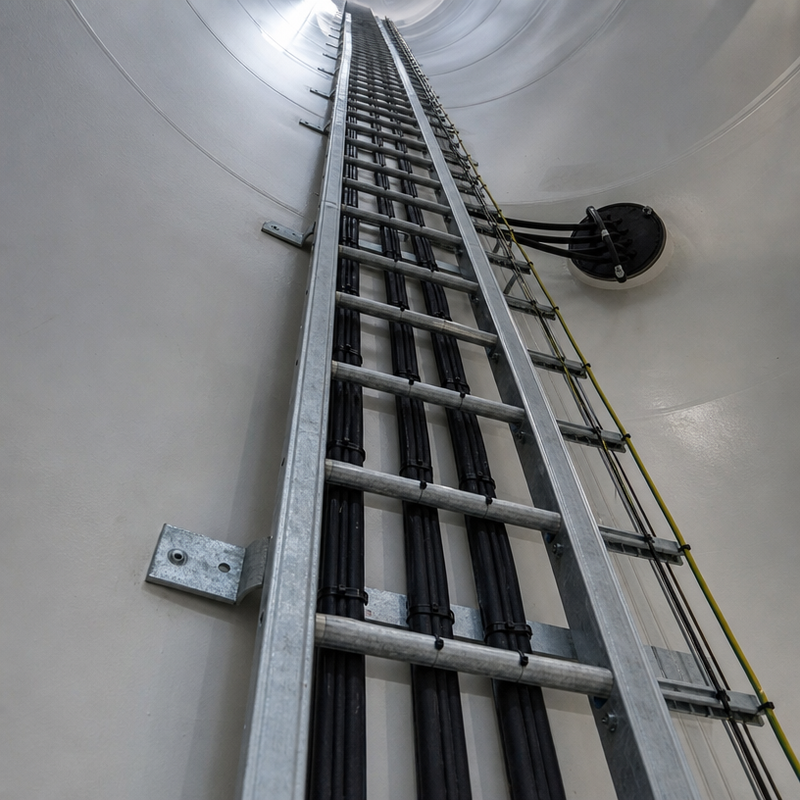
Coastal energy and industrial facilities
Between the floating and the fixed lie the coastal plants that process the energy economy: LNG receiving terminals, desalination plants, coastal power stations and the fabrication and marshalling yards that build the offshore fleet itself. These facilities run continuous electrical systems meters from the sea, under the same corrosion regime as offshore assets but without offshore budgets for exotic materials. They are the largest single market for hot-dip galvanized systems, and they place a premium on one engineering virtue: predictability. When an LNG terminal’s EPC contractor specifies cable tray, it is buying documented load performance, uniform coating and a fittings range that closes the system — because a single-source, fully documented run is what keeps a construction schedule predictable in an environment where weather already owns the calendar.
The procurement shift: buying a system, not a component
Across every marine infrastructure segment, the pattern is identical: cable tray is no longer procured as an afterthought line item. EPC contractors and asset owners are specifying complete systems — straight sections, fittings, supports and documentation from one manufacturer — because the cost of a specification failure in a marine environment is measured in decades, not dollars. Manufacturers that control extrusion, fabrication, galvanizing and testing in-house, and that ship load tables and coating reports with every order, are winning specification battles against suppliers offering undifferentiated product.
Shanghai Qinkai Industrial, a Shanghai-based manufacturer of NEMA-standard tray, ladder, seismic support and stainless steel systems, says marine infrastructure buyers now request coating thickness verification and material traceability at the RFQ stage — before price is even discussed. “In marine infrastructure, the cable support system is specified once and inspected for the life of the asset,” the company said. “The suppliers who thrive are those whose documentation is as corrosion-resistant as their product.”
The view from the construction schedule
For contractors and project owners, the practical message is simple: in marine infrastructure, cable management is schedule-critical. Port electrification retrofits, offshore wind electrical packages and coastal plant expansions all move through the same sequence — design, procurement, installation, energization — and the cable support system sits in the middle of it. Specifying it early, with the right material grade, a complete fittings range and full documentation, is not an engineering nicety. It is the difference between a project that energizes on schedule and one that discovers its corrosion strategy at the first inspection.
The marine infrastructure boom will be measured in gigawatts, berths and terminals. Underneath all of it, mile by mile, runs the cable tray that carries the current — engineered for salt, documented for decades, and finally getting the attention its role deserves.
Post time: Sep-07-2026