
No environment tests a cable support system the way the sea does. On an offshore platform, an FPSO, or a coastal process plant, the atmosphere is salt-laden, humid, and often hot; the structures vibrate and move; and the consequences of a corroded support failing on a live circuit are measured in production loss and safety risk, not repair cost. Shanghai Qinkai Industrial Co., Ltd., a manufacturer of NEMA-standard cable tray and cable ladder systems, says marine and offshore projects are its most specification-driven segment: buyers there do not ask for “a cable tray” — they ask for a material grade, a coating system, a corrosion class, and the documentation to prove all three.
“Onshore, cable tray is often an electrical commodity. Offshore, it is a safety-critical component of the asset’s corrosion strategy,” the company said in a statement. “The sea does not forgive a shortcut. Our marine customers specify hot-dip galvanized or stainless steel systems with published load data, and they inspect the coating report before they inspect the shipment.”
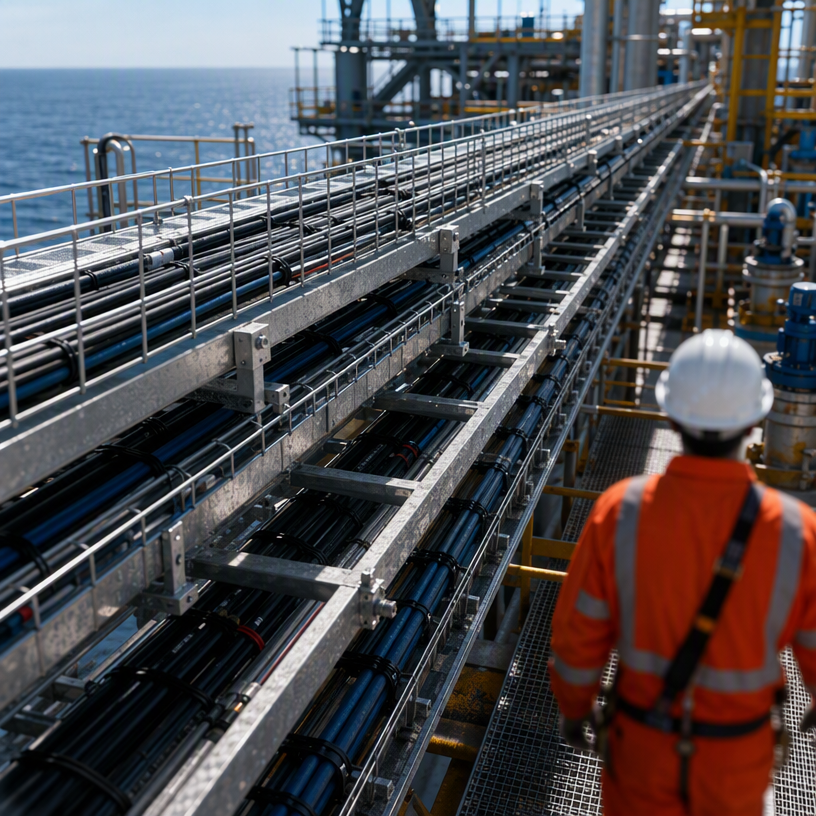
What makes the marine atmosphere different
The engineering logic starts with the environment. Marine atmospheres are classified among the most corrosive on the ISO 12944 scale — category C5-M for high-salinity coastal and offshore zones, with CX reserved for the most extreme offshore exposure. Three mechanisms drive the damage:
Salt deposition. Airborne salt particles settle on steel work, and in the presence of humidity they form an aggressive electrolyte that attacks zinc and steel alike.
Cyclic wetting. Offshore structures move through wet-dry cycles constantly — spray, rain, condensation, and salt fog — and each cycle accelerates corrosion at coating defects and cut edges.
Chloride stress. Chlorides attack galvanized coatings and carbon steel far faster than inland pollutants do, which is why coating thickness and material selection, not paint touch-up schedules, decide system life.
The practical consequence is that the electro-galvanized or painted tray systems common in dry indoor installations have no place in marine specification. Projects standardize on hot-dip galvanized steel per EN ISO 1461 or ASTM A123, or on stainless steel — most commonly Type 316 — for the most severe exposure and for equipment areas where long-term maintenance access is limited.
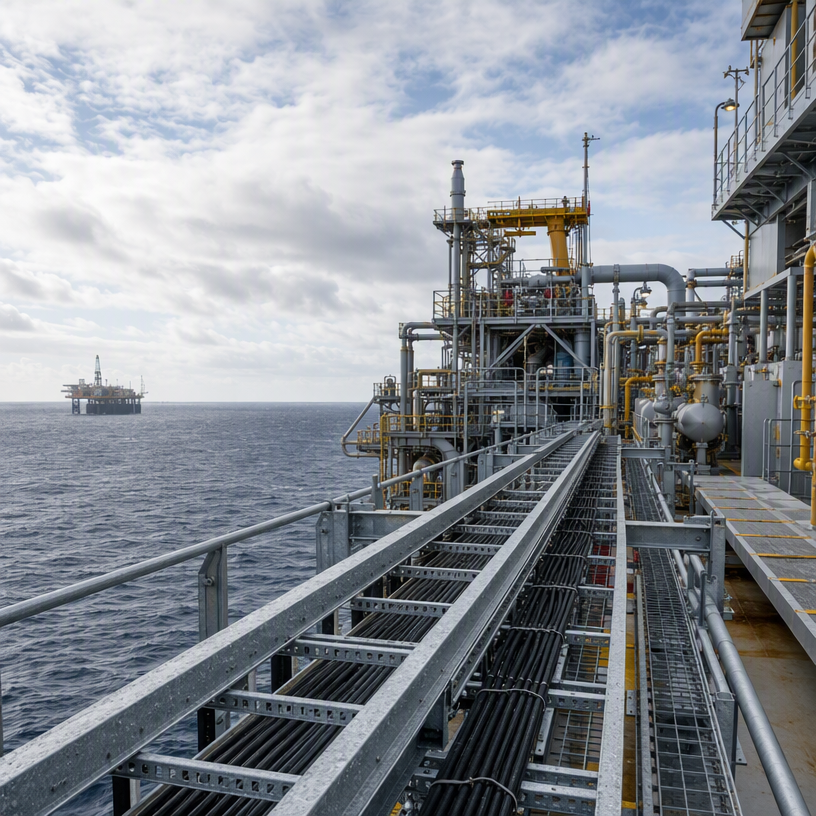
Fixed platforms and FPSO topsides
On fixed offshore platforms and floating production facilities, the cable support system is the nervous system of the asset. Power cables feed process equipment, compression, and pumping trains; instrument and control cables carry signals for process control, safety systems, and emergency shutdown. Both run in dense, multi-level routes through topside modules where space is allocated by the millimeter.
Three requirements dominate topside specification. First, ventilation: process areas generate heat, and the ventilated construction of quality tray and ladder systems allows energized cables to dissipate heat while keeping every cable visible and traceable for inspection. Second, mechanical integrity: the system must hold its rated load under platform motion, vibration from rotating equipment, and the structural deflections of the platform itself — which is why published load tables per width, rung pitch, and support spacing are a tender requirement rather than a catalog convenience. Third, material: topside cable support in the splash zone and process areas is overwhelmingly specified in Type 316 stainless steel or hot-dip galvanized steel, depending on the operator’s corrosion philosophy, with stainless favored where maintenance access is difficult or where fire- and blast-rated walls must be penetrated cleanly.
Vessels and offshore support ships
Ships and offshore support vessels add a different discipline: certification. Cable support systems installed on classed vessels are typically subject to the rules of a classification society — DNV, ABS, Lloyd’s Register among them — and the installation must be traceable to approved materials and drawings. Vessel environments also combine continuous vibration, confined routing through engine rooms and technical spaces, and the need for systems that can be modified during dry dock periods without specialized fabrication on board.
For these reasons, vessel work favors bolted, pre-punched tray and ladder systems with a complete fittings range — bends, tees, crosses, reducers, and drop-out units — so a route can be reconfigured with standard hardware and hand tools. Compact dimensions and predictable section lengths matter as much as corrosion performance, because the space inside a ship’s technical spaces is tighter than almost any onshore plant.
Offshore wind
Offshore wind farms extend the same corrosion rules to a rapidly growing sector. Towers, transition pieces, and offshore substations sit in the same C5-M atmosphere as oil and gas facilities, but with two additional demands: the assets are unmanned, so maintenance windows are short and expensive, and the cabling — medium-voltage array cables, power export circuits, and control and SCADA systems — must remain reliable for the design life of the turbine without frequent intervention.
The specification consequence is a strong preference for stainless steel cable support in nacelle and transition-piece areas, with hot-dip galvanized systems accepted in less exposed locations, and for cable management that keeps conductors organized through vibration-heavy tower interiors. As wind farms move further offshore and into larger formats, operators are applying oil-and-gas-grade cable support specifications to a sector that previously borrowed onshore practice — a shift suppliers are watching closely.
Shipyards, ports, and coastal plants
Not all marine engineering floats. Shipyards build and repair the fleet under open-air coastal conditions; ports operate heavy lifting equipment, container handling systems, and shore power installations in salt-laden air; desalination plants and coastal process facilities run continuous electrical systems meters from the sea. These fixed coastal installations share the offshore corrosion regime without the offshore budget for exotic materials, which makes them the largest market for hot-dip galvanized systems.
For shipyard gantry cranes, quay cranes, and port electrification projects, HDG cable tray and ladder systems per EN ISO 1461 deliver the required service life at a fraction of the cost of stainless — provided the coating is thick enough, the fittings carry the same coating specification as the straight sections, and field-cut ends are treated with zinc-rich repair coating. Single-source supply matters here: when couplers, fittings, and supports come from the same production line as the tray, the coating quality is uniform across the entire run, and the weak points that appear at mixed-vendor interfaces disappear.
Selecting the right material and finish
For engineers specifying cable support in any marine environment, Qinkai’s guidance reduces to four decisions:
Match the grade to the exposure zone. Reserve Type 316 stainless steel for splash zones, process areas, and unmanned assets where maintenance is difficult; use hot-dip galvanized steel per EN ISO 1461 or ASTM A123 for coastal and atmospheric zones; keep electro-galvanized and painted systems out of marine specification entirely.
Think about galvanic corrosion. When stainless steel and aluminum, or stainless and carbon steel, are connected in a salt-laden environment, bimetallic corrosion can destroy the less noble metal. Specify compatible materials or insulated separation at every interface, including fasteners and brackets.
Protect every cut and scratch. Field-cut ends and drilled holes are where marine corrosion begins. HDG’s cathodic protection defends the steel at these points, and zinc-rich repair coating should be applied wherever the coating is damaged on site.
Demand the documentation. Load tables, coating thickness reports, and material certificates are the difference between a specifiable system and a gamble. In marine projects, the coating report is inspected as carefully as the cable tray itself.
Standards that govern marine cable support
The standards framework for marine and offshore cable tray specification is consistent across geographies: IEC 61537 covers test and marking requirements for cable tray and ladder systems; EN ISO 1461 and ASTM A123 govern hot-dip galvanized coatings; ISO 12944 defines the corrosion categories that drive material selection; NEMA VE 1 and VE 2 anchor the North American practice; and classification society rules add a further layer for vessels and floating facilities. Projects increasingly require all of the above to be documented per shipment — a bar that filters out suppliers who cannot produce test-backed load data.
The procurement test
The pattern across every marine segment is the same: the specification is decided by corrosion engineers and asset owners before the electrical contractor is appointed, and the suppliers who win are those who can document material grade, coating performance, and load rating without hesitation. “A marine cable tray is purchased once and inspected for decades,” the company said. “We build ours so that every inspection finds the same thing: a documented system, doing exactly what the specification promised.”
Post time: Sep-02-2026